Digital Marketing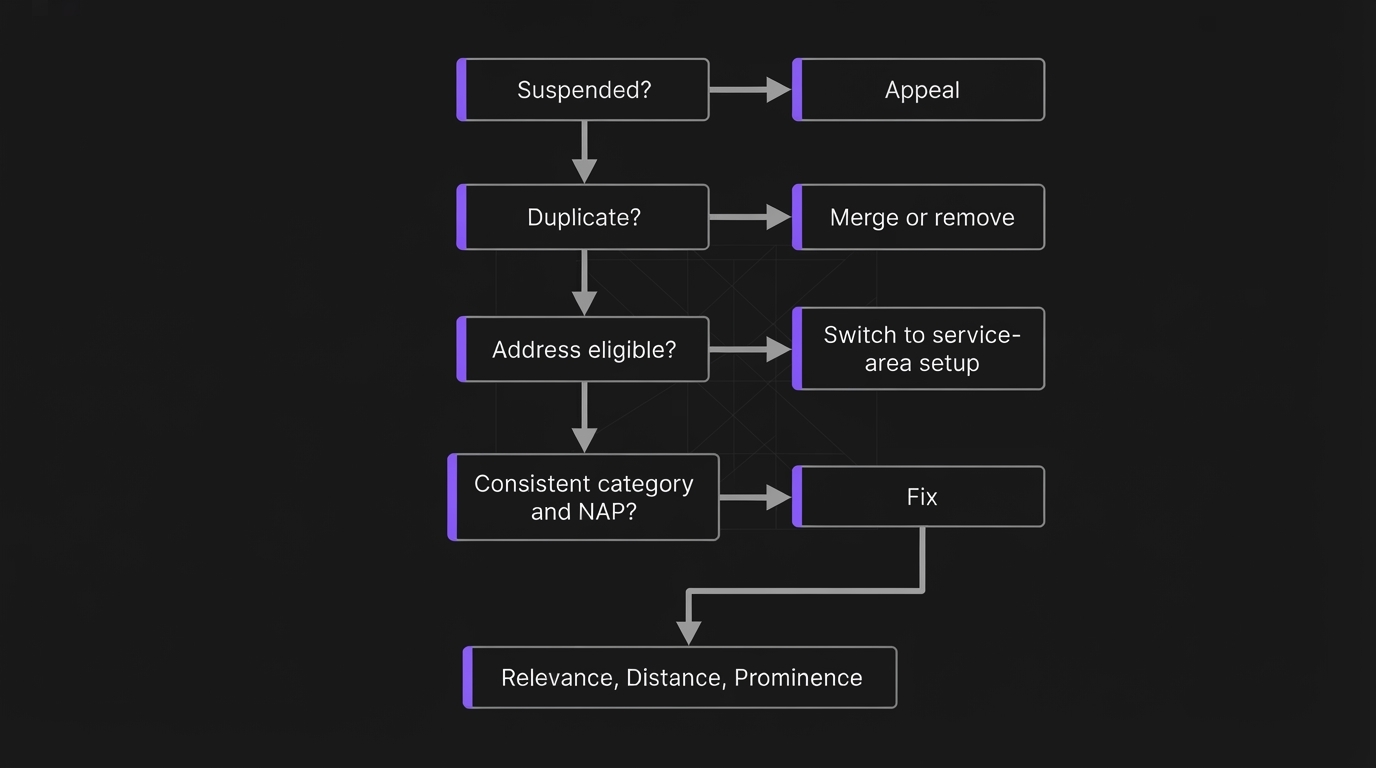
Why Your Google Business Profile Isn't Showing Up (And the Order We Actually Check Things In)
A client called us in a mild panic last month. Her clinic had run on Google Maps for two years, then vanished from search results overnight, no warning she noticed, no email she could find. Her first move was the move almost every guide online tells you to make: freshen the photos, rewrite the business description, ask a few patients for reviews. None of it did anything, because none of it was the problem. The profile was suspended, and no amount of content fixes a suspended account.
That mix-up is common enough that we now check things in a fixed order before touching content at all. Most of the advice ranking for this question skips straight past the first two checks to get to the parts that are easier to write a blog post about.
A profile stops appearing for one of four reasons, roughly in the order we see them in practice: it is suspended, it is being suppressed because Google thinks it duplicates another listing, it fails an eligibility rule (most often a service-area business using an address it should not), or it genuinely ranks so low on relevance, distance, or prominence that it never surfaces for the searches you are checking. The first three are account problems. The fourth is a ranking problem. Fixing a ranking problem does nothing for an account problem, which is exactly where the panic and the wasted afternoon usually happen.
A suspended profile does not announce itself clearly. It disappears from Maps and Search, the Google Business Profile app may still show it to you as if nothing changed, and Google's own notice can arrive by email, sit unread in a spam filter, or apparently never arrive at all, a complaint that shows up often enough in Google's own Business Profile Community to be close to a running theme. Confirm it directly: search your exact business name in quotation marks, ideally from a different device or network. If nothing comes up at all, that is a stronger signal than a drop in ranking position.
Google separates a soft suspension, where the listing exists but is hidden, from a hard one, where the account is disabled outright, and the fix differs. Google's own guidance on fixing suspended or disabled profiles and its appeal process for profile restrictions cover what each state means and what you can edit while a case is under review.
We have made this exact mistake ourselves: two hours rewriting a client's description and swapping in new photos before checking suspension status first. The content was fine. The account was flagged. Nothing written back into the profile mattered until the appeal cleared, and in our experience that has taken anywhere from about a week to several weeks, never on a fixed schedule Google publishes anywhere.
This is the second most common cause we see, and the one that frustrates owners the most, since it often traces back to something they did themselves. A well-meaning employee reclaims the listing after a merger, a rebrand, or a "let's just redo this" afternoon, and now two profiles exist for one business. Google's local algorithm does not average duplicate profiles together. It usually picks one and suppresses the other, and the one it keeps live is not always the one carrying your reviews and history.
Search your business name and scan the map for a second pin nearby, then search old addresses and name variations. Google's guidance on resolving duplicate profiles and ownership issues walks through requesting a merge, but going by the volume of unresolved merge threads in Google's own community, a request alone can sit for weeks. Claiming both listings under one account first, then requesting removal of the one you do not want live, tends to move faster.
This is the check most local SEO content skips, and the one we see break the most service businesses: contractors, coaches, cleaning companies, agencies like ours, anyone who serves clients at their location or online rather than welcoming walk-ins at a storefront. Google's guidelines for representing a business only allow a public address to display if customers can actually visit during posted hours. A service-area business listing a home address it does not want public, or an address it does not operate from, is violating a documented policy, not a technicality.
The fix costs nothing: set the business as a proper service-area business, hide the address, define the areas served, and stop listing a location nobody can walk into. It is the single most effective fix on this list for anyone running a business from a home office or serving clients on-site, which describes plenty of the small businesses we work with.
Once the account itself is clean, the next layer is the primary category, and it carries more weight than most owners assume. Category is one of the stronger signals in Google's own guidance on improving local ranking, ahead of almost anything you can write in the description field. Pick the most specific category available rather than the broadest one, and match your business name, address, and phone number exactly across your website, your profile, and the citation sites that actually get checked. A mismatch here will not get you suspended. It just makes Google less confident your profile and your website describe the same business, which quietly caps how far the next layer can carry you.
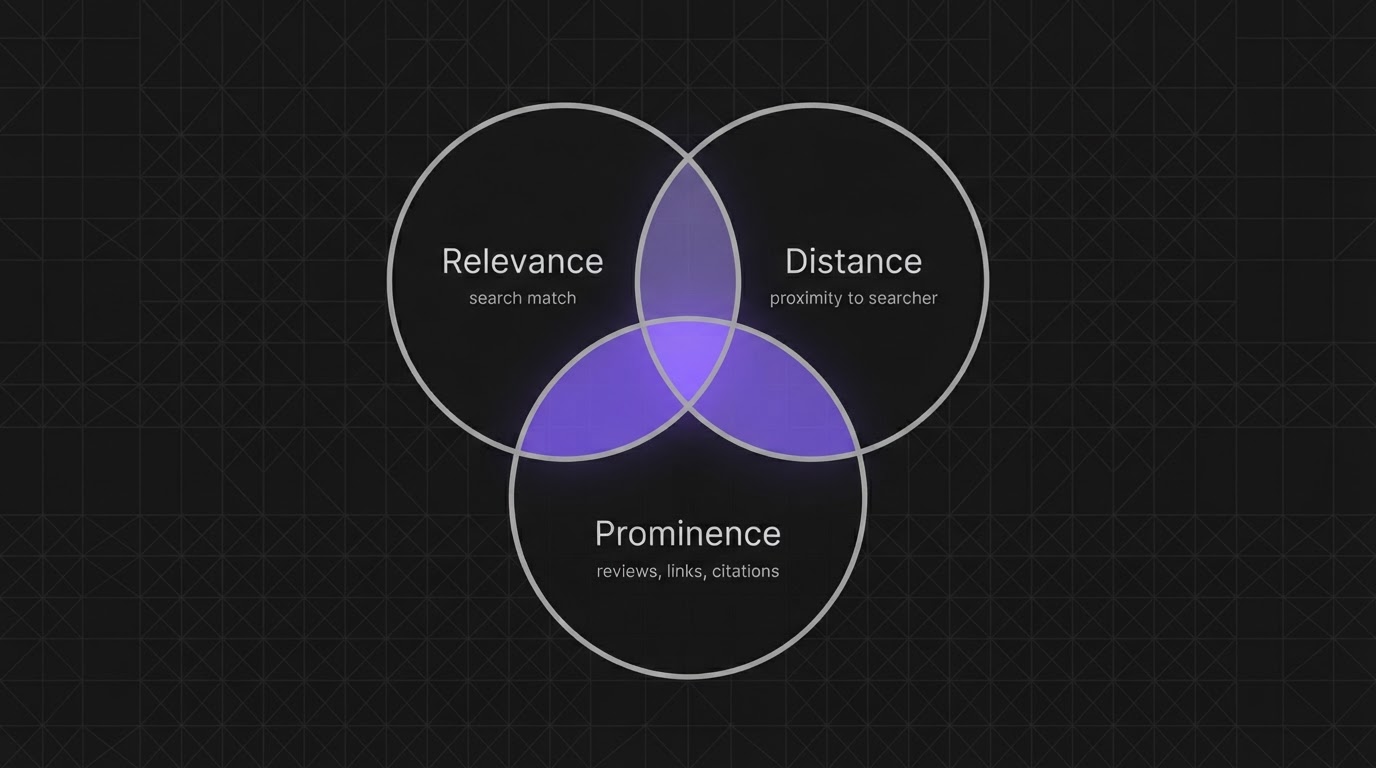
This is where almost every other article on this topic starts, and it is genuinely the right layer to work once the first four checks are clean. Google names these three factors directly: how well the profile matches what someone searched, how far the searcher sits from the business or the edge of its service area, and how well known the business is based on information Google has gathered from across the web, reviews and links and citations included. Reviews and posts belong here, and they do help. They just do not help before the earlier checks pass. A five-star review count does nothing for a profile Google is not showing to anyone yet.
Most of the content ranking for this question is not wrong, exactly. It is answering a business owner's third problem as if it were the first one, and we think that ordering mistake costs more visibility than any technical error most owners actually make.
If you have run all four checks and the profile is clean (suspension-free, unique, eligible, and consistent) and it still is not showing where you expect, the honest next step is a proper local SEO audit rather than another guess, the kind of diagnostic work our SEO services cover. We made a similar argument in the CRM and marketing integration guide: fix the plumbing before spending on the parts everyone notices. A listing that cannot appear at all will sink the return on any lead generation system built on top of it, which is what we mean by a connected growth system: the visibility layer works before the rest of the system has anything to route.
If you are mid-diagnosis right now and want a second pair of eyes on it, book a strategy call and we will walk through what your profile actually looks like from the account side, not just the parts you can already see.
We would like to hear which check turned out to be the real problem for you. The order above comes from a decent sample of client accounts, not a universal law, and we are curious where it holds and where it does not.
Search your exact business name in quotation marks from a different device or network. If the listing does not appear at all, rather than showing up lower in the map results, treat it as a suspension first. Google's guidance on fixing suspended or disabled profiles explains the difference between a hidden listing and one that simply ranks poorly.
Yes. Google's guidelines for representing a business only allow a public address if customers can visit during posted hours. A service-area business showing an address nobody can walk into is a documented policy violation, and it is one of the more common causes we see behind suspensions on businesses without a storefront.
Google does not publish a fixed timeline. Cases we have handled have cleared anywhere from about a week to several weeks. Google's own appeal process for profile restrictions lets you track a submitted case, and the practical advice from its Business Profile Community is to submit once with complete documentation rather than resubmitting repeatedly.
Usually because a second profile exists for the same business under a slightly different name, address, or an old location, often created by a past employee or a previous agency. Google's guidance on resolving duplicate profiles covers requesting a merge, though claiming both listings under one account first tends to move faster than waiting on Google to merge them.
Not until the account-level problem is fixed. Reviews and posts feed the prominence factor in Google's local ranking system, but prominence only matters once your profile is eligible to show at all. Fix suspension, duplication, and address eligibility first, and reviews and posts start doing real work after that.
GOOGLE PREFERRED SOURCES
Add BDGS Digital as a Preferred Source in Google and make our latest SEO, CRM, automation, advertising, AI, and marketing technology insights easier to discover.
Add BDGS Digital
Written by
Benison David Sanchez is the CEO and AI Digital Marketing Strategist of BDGS Digital, a technology, CRM, automation, and growth company based in the Philippines and serving clients globally. He leads digital marketing and client acquisition for the company, and over five years has worked with more than 100 businesses across ecommerce, service, coaching, accounting, and technology, building connected growth systems where every campaign ties back to a larger system rather than running in isolation. Local SEO diagnostics like this one are part of what he handles directly for client accounts.
View all articles by BenisonWant help building this?
BDGS Digital builds connected growth systems across CRM, automation, marketing, and technology. Explore our services or book a strategy call.
Book a Strategy CallLET'S TALK
Book a strategy call and we'll map how your CRM, automation, marketing, and technology can work together as one connected system.