Technology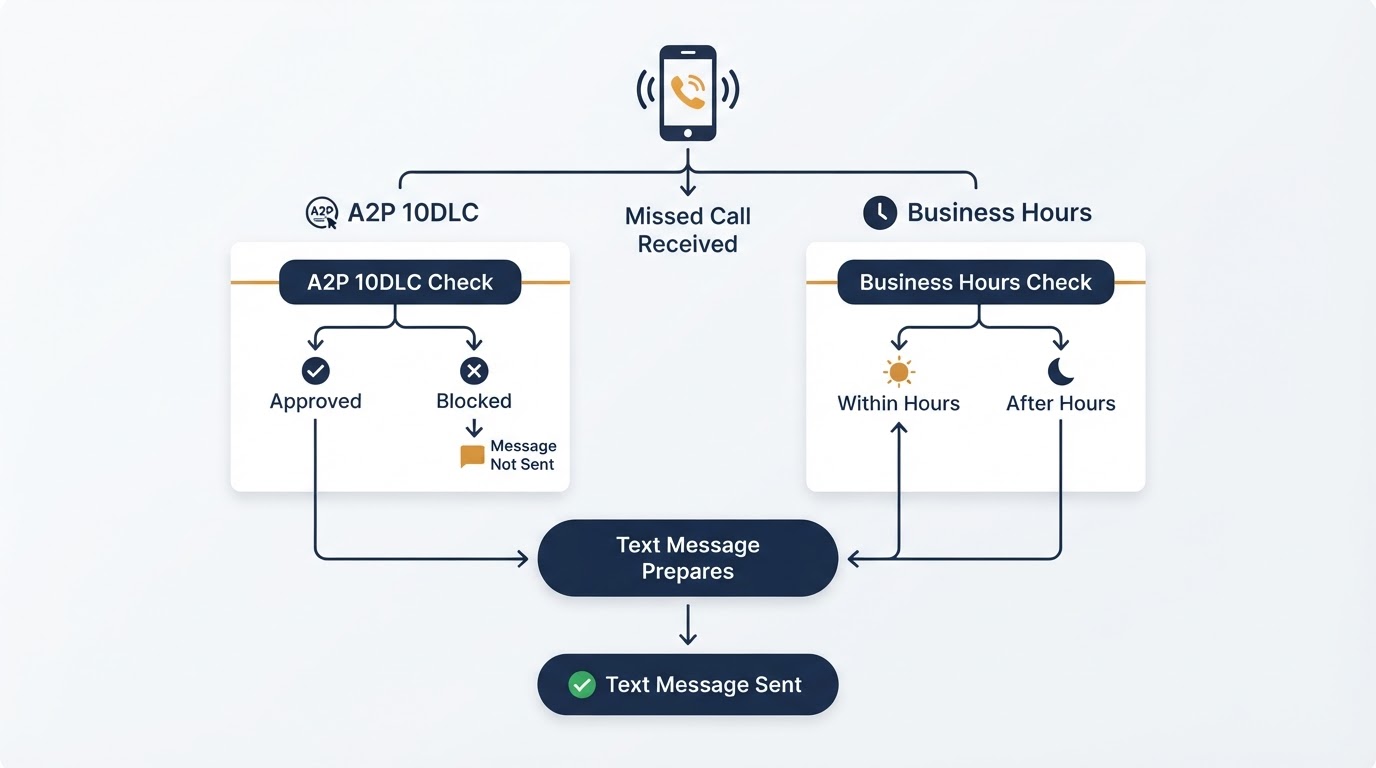
Your Missed Call Text Back Automation Probably Isn't Compliant Yet
We turned on missed call text back for a client's HVAC sub-account in GoHighLevel last month. The setup itself took twenty minutes: caller reaches voicemail, a workflow fires, a text goes out within seconds asking how we can help. Felt done.
Then we checked two things before calling it finished. First, whether the number's A2P 10DLC campaign was actually approved to send that text at all. Second, whether the workflow would fire the same way at 11pm on a Tuesday as it would at 11am. Neither was true on the first pass, and neither shows up in most of the guides small business owners use to set this feature up themselves.
Missed call text back is one of the highest-leverage automations a small business can run. Someone calls, nobody picks up, a text goes out before they've hung up and called a competitor. But two things sit underneath the feature that most tutorials skip entirely: whether the number is registered to send that text at all, and whether the hour it fires is defensible. Here's what we check, in the order we check it.
We read through several of the current guides ranking for "missed call text back," including step by step tutorials that cover message copy, opt-out language, and basic FCC and TCPA references. Most stop at telling you to include "Reply STOP to opt out" and call it compliant.
None of them mention A2P 10DLC campaign registration, the carrier-level approval that determines whether an automated text actually reaches a phone. On the other side, the guides that do cover A2P 10DLC registration in real depth, written for agencies running GoHighLevel, are thorough on brand and campaign mechanics and never once connect it back to missed call text back specifically. Two closely related problems, covered in two separate sets of guides that don't reference each other, and a business owner following either one in isolation ends up with a text that either doesn't send or sends at an hour that gets them a complaint.
We treat missed call text back the same way we treat how we route form leads in GoHighLevel: it's a lead channel, not a novelty feature, and it deserves the same setup discipline before it goes live.
Yes, and this is the part that gets skipped most often. A2P 10DLC (Application-to-Person, 10-Digit Long Code) is the registration system US carriers require before a business phone number can send automated texts at volume. GoHighLevel's own documentation states registration is "mandatory before you can begin sending A2P messages using 10DLC phone numbers," including the ones your missed call text back workflow sends.
The failure mode is the dangerous part. An unregistered or rejected campaign doesn't bounce back with an error. GoHighLevel marks the message sent inside your sub-account, but carriers filter or block unregistered traffic at the network edge, so it never reaches the caller's phone. You keep believing the automation is working while every missed call quietly goes unanswered a second time.
Registration itself is not expensive. Based on GoHighLevel's current published fees, a Sole Proprietor or Low Volume Standard brand runs a one-time fee near $24.50, a High Volume Standard brand runs about $71.91, and monthly campaign fees range from around $2 for a Sole Proprietor starter campaign to $10 for a standard use case, on top of per-message carrier fees of roughly $0.003 to $0.005. GoHighLevel does not publish a guaranteed approval window; campaigns sit in a "Pending" state during carrier vetting. In the sub-accounts we've registered, an approval or rejection has typically landed within a few business days, though that is a pattern we've observed, not a published SLA.
When a campaign does get rejected, it's rarely random. GoHighLevel's own rejection documentation lists specific, fixable reasons: a website that's just a lead form with no business description, an unchecked or missing SMS consent checkbox, a Sole Proprietor registration that describes itself like a corporation, or a privacy policy that doesn't disclose the SMS program. None of these are ambiguous once you know to look for them, and resubmission after a fix costs nothing extra. This is exactly the kind of setup we handle inside our automation work, since a workflow that fires on a rejected campaign is not actually automating anything, it's just failing quietly on schedule.
This is where we'd push back on a claim we see repeated as flat fact across compliance guides: that the TCPA requires all texts to stay inside an 8am to 9pm window. It's more contested than that, according to legal analysis of the underlying regulation. The quiet hours restriction sits in the FCC's implementing regulations under the TCPA, 47 CFR § 64.1200, and was written to restrict "telephone solicitation" calls to residential numbers. Whether it applies to an automated text reply the same way it applies to a live sales call is an active legal question. Plaintiff firms have been filing a wave of class actions arguing it does, and defense-side commentary has pushed back that the regulation's text and history don't clearly extend that far to SMS. Treat 8am to 9pm recipient local time as the safe practical default, not as settled case law, because several states layer stricter rules on top of the federal baseline anyway.
Here's the part that actually surprised us. GoHighLevel's missed call text back feature has no built-in time restriction. A user flagged this directly on GoHighLevel's own public feature request board, asking for automatic quiet hour controls and warning that fines for non-compliant messaging "can range from hundreds to thousands of dollars per message." As of this writing, the feature still fires the instant a call is missed, any hour, unless the business builds the check itself.
The fix is a workflow-level condition, not a GoHighLevel setting. Add an if/else step at the top of the missed call text back workflow that checks the current hour against a business hours custom value before the SMS action runs. Outside the window, route to a delayed action that holds the text until the next allowed hour rather than skipping it, because a missed lead is worse than a slightly late text. We build these for clients whose customers sit in Ohio, Alberta, and Queensland, which are all several hours off from Manila, so the check has to run against the recipient's local time, not the sub-account's server time or ours.
Three checks, in order, take about ten minutes:
If any of the three fails, fix it before the workflow sends another text, not after the next complaint. Every missed call that gets a compliant reply also becomes a contact record, so this is worth pairing with a genuine look at keeping a CRM usable, since a pipeline full of contacts nobody follows up on defeats the point of answering the call in the first place.
Missed call text back is still worth running. The mechanism is sound and the leads it saves are real. But it is not a five-minute toggle the way most guides present it, and treating it that way is how a genuinely useful automation turns into a compliance exposure nobody notices until a customer complains or a carrier starts filtering the number entirely. Register the campaign first, build the time check into the workflow, and check both again any time you move the number to a new sub-account.
If you've built this on a different platform and it handles quiet hours natively, we'd like to know which one and how. We haven't found a mainstream CRM that solves it without a manual workflow step, and we'd rather be wrong about that than keep telling clients to build it themselves.
If you're trying to connect missed call text back, lead routing, and your CRM into one system and it keeps breaking at a step like this one, book a strategy call. We'll map what you have running now and where it's actually leaking.
Yes. GoHighLevel requires an approved A2P 10DLC campaign before any A2P text can send reliably, including automated missed call text back messages. An unregistered or rejected campaign does not fail loudly. Carriers filter the messages at the network edge, so texts appear to send from inside GoHighLevel but never reach the recipient's phone.
Nothing crashes and no error appears in most workflows. The message gets marked sent inside GoHighLevel, but major US carriers filter or block unregistered traffic before it reaches the recipient, so you lose leads silently while believing the automation is working.
As of this writing, GoHighLevel's published fees list a one-time charge near $24.50 for Sole Proprietor or Low Volume Standard registration and about $71.91 for High Volume Standard, plus a monthly campaign fee of around $10 for standard use cases and roughly $0.003 to $0.005 per message in carrier fees.
It's legally uncertain rather than clearly settled either way. The TCPA's quiet hours language was written for telephone solicitation calls, and whether it applies the same way to an automated text reply is currently being litigated. Treat 8am to 9pm recipient local time as the safe default until that question is resolved.
GoHighLevel's own documentation does not publish a guaranteed approval window; campaigns sit in a Pending state during carrier vetting. In the sub-accounts we've registered, approval or rejection has typically shown up within a few business days, and a rejected campaign can be corrected and resubmitted at no extra charge.
GOOGLE PREFERRED SOURCES
Add BDGS Digital as a Preferred Source in Google and make our latest SEO, CRM, automation, advertising, AI, and marketing technology insights easier to discover.
Add BDGS Digital
Written by
Benison David Sanchez is the CEO and AI Digital Marketing Strategist of BDGS Digital, a technology, CRM, automation, and growth company based in the Philippines and serving clients globally. He leads digital marketing and client acquisition for the company, and over five years has worked with more than 100 businesses across ecommerce, service, coaching, accounting, and technology, building connected growth systems where every campaign ties back to a larger system rather than running in isolation. He writes about what those builds actually look like, including the parts that break, like a missed call text back workflow that looked finished twenty minutes in and wasn't.
View all articles by BenisonWant help building this?
BDGS Digital builds connected growth systems across CRM, automation, marketing, and technology. Explore our services or book a strategy call.
Book a Strategy CallLET'S TALK
Book a strategy call and we'll map how your CRM, automation, marketing, and technology can work together as one connected system.