A thread in r/agency from earlier this year has an agency owner quoting $5,000 a month to run Meta ads, with a $25,000 minimum monthly spend attached before they will take the account. A different thread has a business owner paying $2,500 a month on roughly $15,000 of spend, asking the room whether he is being robbed. Both prices are normal. Neither number tells him anything useful, because how much Facebook ads management costs and whether it is worth buying are two different questions, and almost every pricing page published on this topic only answers the first one.
So this post answers the second one. There is a single calculation that tells you whether a management fee will make you money at your spend level, it takes about two minutes, and I have not found it published anywhere on page one.
How much does Facebook ads management cost?
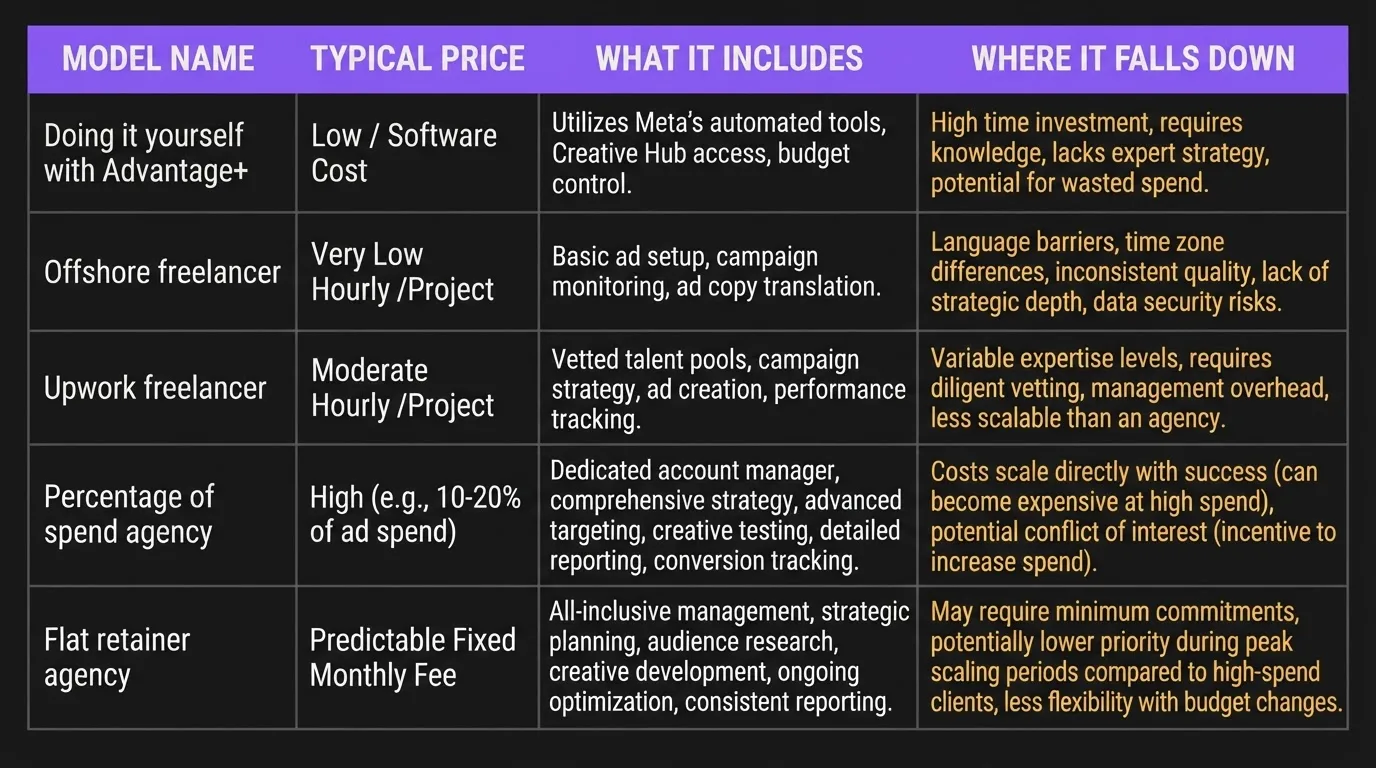
Facebook ads management costs between 10 and 20 percent of ad spend at most agencies, $500 to $5,000 a month on a flat retainer, or $15 to $40 an hour for a freelancer on Upwork. Agencies almost always attach a monthly minimum, so at low spend you pay the floor rather than the percentage. WebFX, for example, publishes its own fee tiers openly: 15 percent of spend with a $975 monthly minimum at its mid tier, dropping to 12 percent with a $4,500 minimum at enterprise.
Those are the list prices. Here is the fuller picture of what you can actually buy.
| What you are buying | Typical price | What it usually includes | Where it falls down |
|---|---|---|---|
| Doing it yourself with Advantage+ | $0 plus your hours | Meta’s AI handles audience, placement and budget allocation | Nobody owns creative, offer or what happens after the lead arrives |
| Offshore freelancer | $5 to $7 an hour in the Philippines, roughly $960 a month full time | Campaign setup, daily monitoring, basic reporting | Execution without strategy. They will run what you tell them to run |
| Upwork freelancer | $15 to $40 an hour, or $500 to $2,000 a month for ongoing management | Setup, optimisation, sometimes creative | Usually one person, no redundancy, variable quality |
| Percentage of spend agency | 10 to 20 percent, with a monthly floor | Full account management, creative, reporting | The floor means you overpay badly below roughly $5,000 spend |
| Flat retainer agency | $2,000 to $5,000 and up, often with a spend minimum | Strategy, creative production, media buying, reporting cadence | Priced for a business bigger than the one asking the question |
Setup fees, and where quotes get strange
Setup fees are a separate line and they are where quotes get strange. One owner in r/FacebookAds reported a $7,000 setup charge on top of a $2,000 monthly fee, and the top reply said plainly that they charge none and would be careful with anyone who does. Roughly my view too. A setup fee is defensible when someone is genuinely rebuilding your pixel, your conversions API and your product catalogue. It is not defensible as a signing bonus.
How much does it cost to hire a Facebook ads manager instead of an agency?
A freelance Facebook ads manager costs $15 to $40 an hour on Upwork, or around $960 a month for a full time Filipino specialist. An in house hire is the expensive option once you count salary, tools and the months where the account does not need forty hours of attention.
I am based in the Philippines, which is where a large share of that offshore ads labour actually sits, so let me say something a US agency’s pricing page will never tell you. The $6 an hour rate is real and the people are competent. What you get for it is execution: someone who will build the campaigns, watch the numbers daily, pause the losers and send you a report on Monday. What you do not get for it is somebody who will tell you that your offer is the problem, or that your leads are dying in an inbox nobody checks after 6pm, or that you are measuring the wrong conversion event. That judgement is what the price gap between $6 an hour and $2,500 a month is supposed to buy. Sometimes it does. Often it does not, and that is the part worth checking before you sign.
The arbitrage is real, in other words, but narrower than buyers think. You are not getting a $2,500 service for $960. You are getting a genuinely good $960 service, which for plenty of businesses is the right purchase.
What does that fee actually buy you in 2026?
Less media buying than it used to, and that is the shift almost nobody selling ads management wants to discuss.
Meta’s own Advantage+ page claims a 20 percent improved cost per acquisition on Advantage+ sales campaigns, a 10 percent lower cost per qualified lead on Advantage+ leads campaigns, and a 7 percent improved CPA on app campaigns. Those are vendor numbers and should be read as vendor numbers. But the direction is not in dispute. The end to end Advantage+ solutions apply AI across audience, placement and budget, which are the three levers a media buyer used to spend their week pulling.
Underneath that sits a rebuild of the ads system itself. Meta’s engineering team published the Andromeda retrieval engine on 2 December 2024, describing a machine learning system that narrows tens of millions of ad candidates down to a few thousand before the auction even runs. Meta reports a 6 percent recall improvement and a 22 percent increase in ROAS for advertisers who activated Advantage+ creative. The point for a buyer is structural: the matching problem, which used to be the skilled part of the job, has largely moved inside Meta’s stack.
So when someone quotes you 15 percent of spend in 2026, the honest question is not “are they good at targeting.” It is “what are they doing that Meta’s AI is not already doing for free.”
- Creative volume and direction. Andromeda’s design assumes lots of creative variants to choose between. Someone has to produce them and decide what to test. Meta will not write your offer.
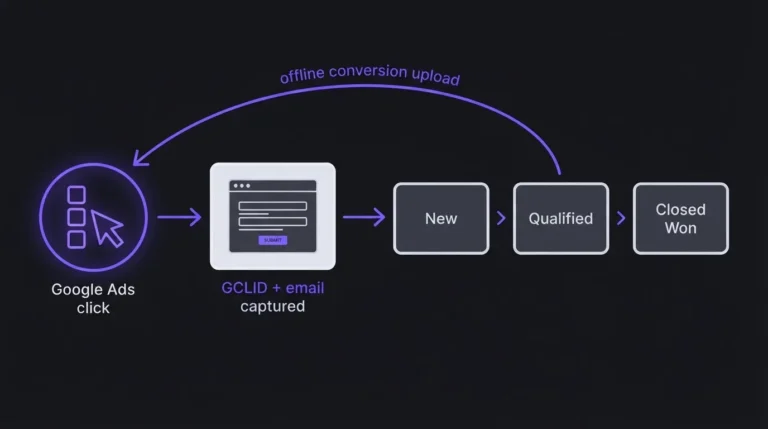
- Measurement that is actually wired up. Server side conversions, a clean event structure, offline conversion imports when the sale closes on a call rather than a cart. Most accounts I look at are optimising toward an event that does not represent revenue.
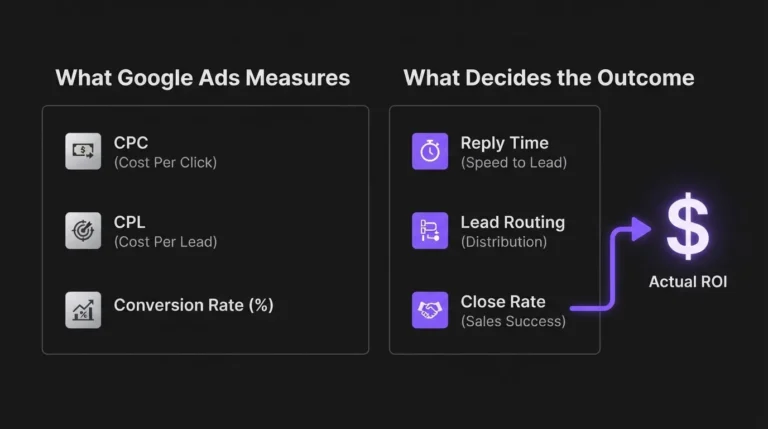
- What happens after the click. This is the one that pays. An ad account that produces 60 leads a month into a system where nobody replies for four hours is not an ads problem. Routing that form submission to the right owner with a reply inside two minutes usually moves the economics more than any bid adjustment will.
- Budget discipline and the boring stuff. Meta’s own budget guidance notes it may spend up to 75 percent over your daily budget on any given day, averaging out across the week, and that campaigns need at least seven days to learn. Plenty of accounts get strangled by an owner who panics and edits on day three.
Note what is missing from that list: audience selection, placement selection, and moment to moment bid management. If a proposal is mostly about those, you are paying a percentage for a button.
The break-even number nobody publishes
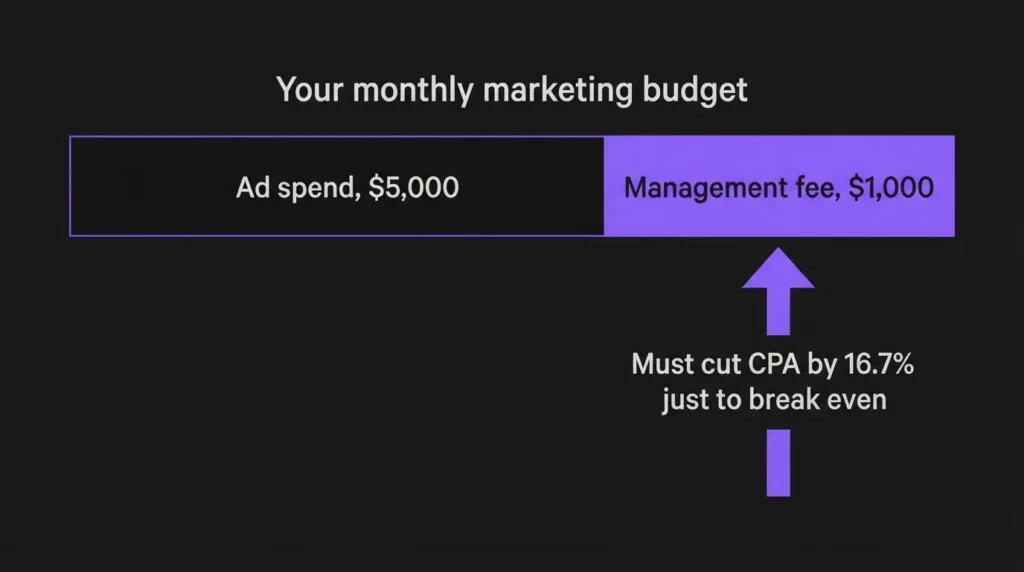
Here is the calculation. Your management fee has to cut your cost per acquisition by at least the percentage that the fee represents of your total outlay, or it loses you money.
Required CPA improvement = fee divided by (ad spend + fee)
That is the whole thing. It works because a fixed marketing budget split between ads and fees leaves less money in the auction, so the manager has to buy each conversion more cheaply just to arrive back where you started.
Say you are spending $5,000 a month on ads and a quote comes in at $1,000. Your total outlay is $6,000, the fee is 16.7 percent of it, and the manager has to reduce your cost per acquisition by 16.7 percent before you see a single extra dollar. Not improve it. Reduce it by a sixth, permanently, against the version of you who spent the full $6,000 on ads.
Two honest caveats before you use this to argue with a salesperson.
It assumes your budget is fixed and that the manager’s job is media efficiency. If they also rebuild your creative, fix your tracking or plug the hole between the ad and the follow up, the gains come from somewhere the formula does not see, and it will understate them badly. That is the strongest argument against my own number and I think it usually wins for accounts above a certain size.
It also assumes you are a competent DIY baseline. If your current account is genuinely broken, targeting a pageview event, running one creative since March, the manager’s hurdle is much lower than the formula suggests because the starting point is bad.
Run the number at three spend levels
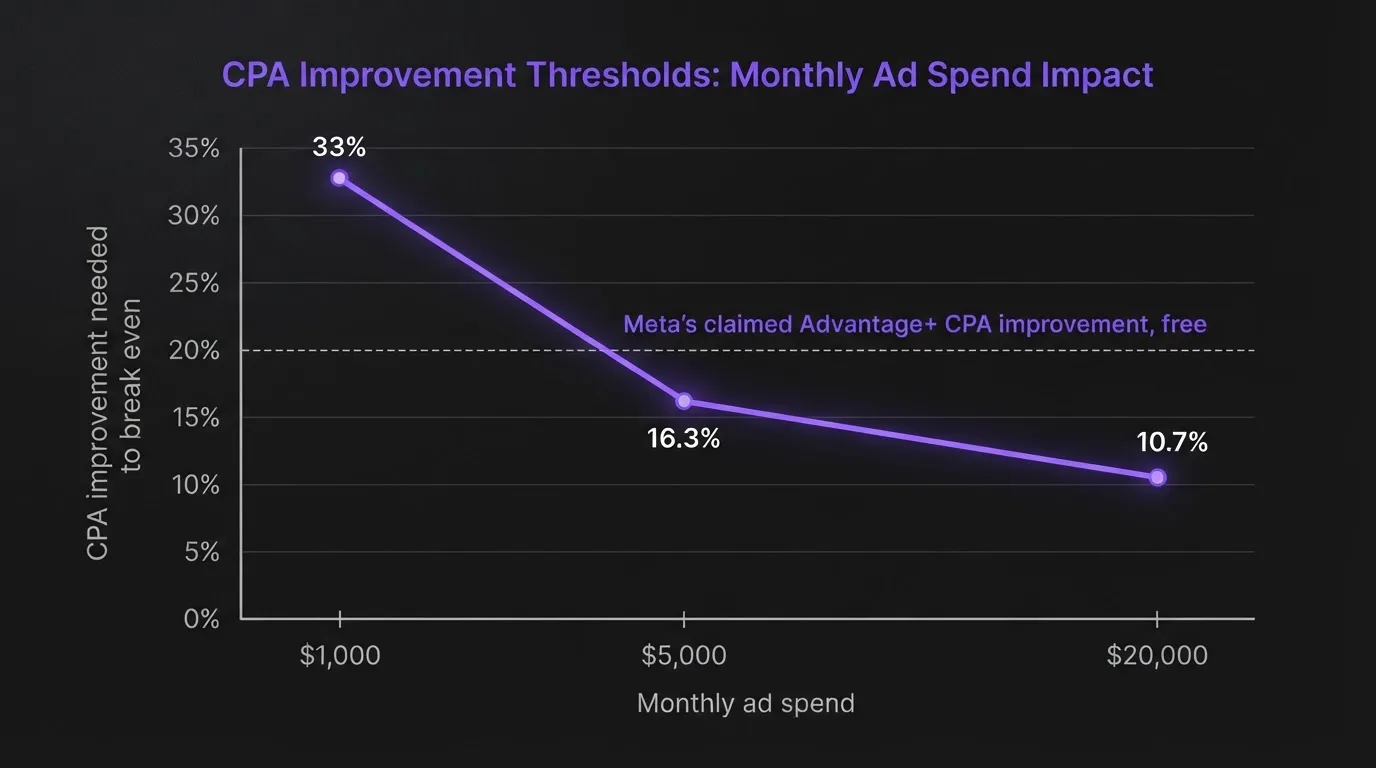
Read the right hand column from the bottom up and the whole pricing debate resolves itself. The hurdle falls as spend rises, because the fee shrinks as a share of what you are putting on the table.
| Monthly ad spend | Realistic fee | Total outlay | CPA improvement needed to break even |
|---|---|---|---|
| $1,000 | $500 floor | $1,500 | 33 percent |
| $5,000 | $975 at a 15 percent tier with a floor | $5,975 | 16.3 percent |
| $20,000 | $2,400 at 12 percent | $22,400 | 10.7 percent |
Put real numbers on the worst case. WebFX’s survey of 250 plus US advertisers, updated 28 May 2026, puts cost per lead between $8 and $25 for most businesses. Say yours is $15. With $1,500 a month to work with and nobody managing it, all $1,500 goes into the auction and you buy 100 leads. Hire someone at $500 and only $1,000 reaches the auction, so they have to bring your cost per lead down to $10 just to hand you back the same 100 leads. Same platform, same auction, a third less money behind the creative.
That is not a fee problem. That is arithmetic, and no amount of agency skill fixes it.
When you should not hire anyone
Below roughly $3,000 a month in ad spend, do not buy ads management. Buy something else.
I say that knowing we sell this service, and knowing it costs us some enquiries. But someone in r/FacebookAds put it better than I would have, arguing that at a low budget every dollar of management fee is a dollar taken out of the ad spend and out of the data the account needs to learn. That is right, and it is right for a reason the formula shows: the fee is not just a cost, it is a percentage hurdle, and at small spend the hurdle is above what media buying skill can reliably clear.
What to spend the money on instead, in order:
- Creative. Three to five genuinely different ad concepts, not five colour variants of one. This is the thing that moves results most at any spend level and it is the one Meta’s AI cannot do for you.
- Tracking. Get the conversions API working and optimise toward an event that means revenue. A weekend of work, permanent effect.
- The follow up. If leads arrive and sit, fix that before you spend another dollar on reach. A lead system rather than a campaign is what turns ad spend into revenue.
- One paid audit. A few hundred dollars for someone experienced to look at the account and tell you what is wrong, with no retainer attached. Best value purchase in this entire category and almost nobody offers it, which tells you something about how the industry prefers to be paid.
Then come back to the fee question when your spend has doubled.
What to ask before you sign anything
Four questions. The answers sort the proposals quickly.
“What is your fee as a percentage of my total outlay, and what CPA improvement does that require?” Ask them to do the division in front of you. A good operator will have thought about this. A bad one will tell you it is not how they look at it.
“What are you doing that Advantage+ is not?” If the answer is about audiences and placements, keep looking. If it is about creative volume, measurement architecture and what happens to the lead after it lands, you are talking to someone who has been paying attention.
“What does month one look like, and what does month six look like?” Ads management done properly is front loaded. If the work is identical in both months, you are paying a subscription for someone to look at a dashboard.
“What happens to my ad account, pixel and data if we stop working together?” Ask it early and the answer should be immediate and boring. In one thread I read while researching this, a business owner’s real problem was not the fee at all, it was being locked out of his own ad account. Own your Business Manager. Grant access, never transfer ownership.
The pattern underneath all four: you are not buying someone to press buttons in Ads Manager. You are buying the connection between the ad, the CRM and the follow up, which is where the money leaks. We build Meta campaigns wired to the CRM for that reason, and the campaign is usually the least interesting part of the build. The longer argument for why the pieces have to connect is in what a connected growth system actually is.
Frequently asked questions
Between 10 and 20 percent of ad spend at most agencies, $500 to $5,000 a month on a flat retainer, or $15 to $40 an hour for a freelancer. Agencies attach monthly minimums, commonly around $975 to $1,500, so below roughly $5,000 in spend you pay the floor rather than the percentage and your effective rate climbs sharply.
Yes. Meta Ads Manager is free to use and you only pay for the ads you run. Any cost beyond media spend is what you pay a person or agency to operate it. Meta’s guidance suggests starting with at least $5 a day over six days so the delivery system has enough data to optimise.
Upwork lists Facebook and Meta ads freelancers at $15 to $40 an hour, with ongoing monthly management typically $500 to $2,000. Filipino specialists are listed around $5 to $7 an hour, roughly $960 a month full time. The lower rate buys competent execution. Strategy, creative direction and measurement architecture usually sit at the higher end.
Not for anything with a conversion goal. Meta recommends at least $5 a day over six days, and campaigns need about seven days of stable budget to exit the learning phase. At $1 a day the algorithm never gathers enough conversion data to optimise, so you pay for impressions and learn nothing usable.
Run the break-even: fee divided by ad spend plus fee gives the CPA improvement required. Below about $3,000 a month in spend the hurdle usually exceeds 20 percent, which is hard to clear consistently. Above roughly $10,000 a month the hurdle falls near 10 percent and a competent manager clears it on creative testing alone.
If you are staring at this decision right now
If your ads, CRM and follow up are three separate things held together by somebody remembering to check a tab, book a strategy call and we will map where it is leaking before anyone talks about a retainer.
Two things I would like pushed back on. First, the formula assumes a fixed total budget, and I know plenty of operators treat the fee as additional rather than carved out of spend. If that is you, the hurdle is lower and my number is too harsh. Second, I have put the floor at $3,000 a month based on how the arithmetic behaves against Meta’s own automation claims, not against a dataset of accounts. If you have run both sides of that line and it broke somewhere else, I want to hear where.