Digital Marketing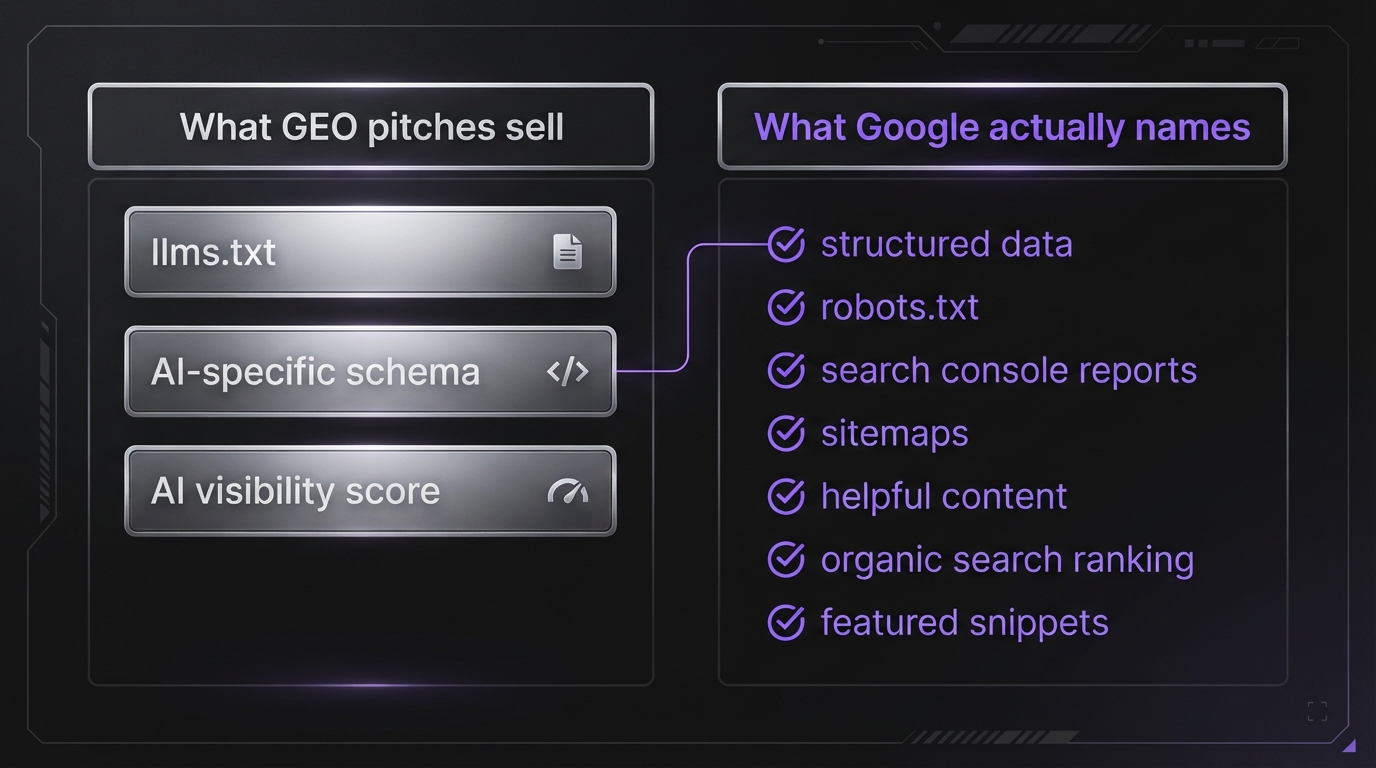
What Google Actually Requires to Rank in AI Overviews
A prospect forwarded us a proposal last month for "Generative Engine Optimization": an llms.txt file, "AI specific schema markup," and a monthly AI visibility score, billed on top of the SEO work we already run for them.
We read Google's own documentation on AI Overviews and AI Mode before answering, and it settles the question faster than the pitch did: no additional technical requirements, no new files, nothing to install. Here is what Google actually names, and what we told them instead.
Nothing beyond what already qualifies a page for regular Google Search. Google's Search Central documentation states the bar directly: "To be eligible to be shown as a supporting link in AI Overviews or AI Mode, a page must be indexed and eligible to be shown in Google Search with a snippet." Beyond that: "There are no additional technical requirements." On the point most GEO pitches lean on: "You don't need to create new machine readable files, AI text files, or markup to appear in these features."
That rules out most of a typical GEO deliverable list: a dedicated AI text file, AI-only schema, a separate crawl strategy for AI bots. What differs is how Google picks pages to show: "query fan-out," breaking one search into related subtopics and pulling in "a wider and more diverse set of helpful links" across them. Your page needs no new engineering, just to already qualify for search and answer one subtopic well.
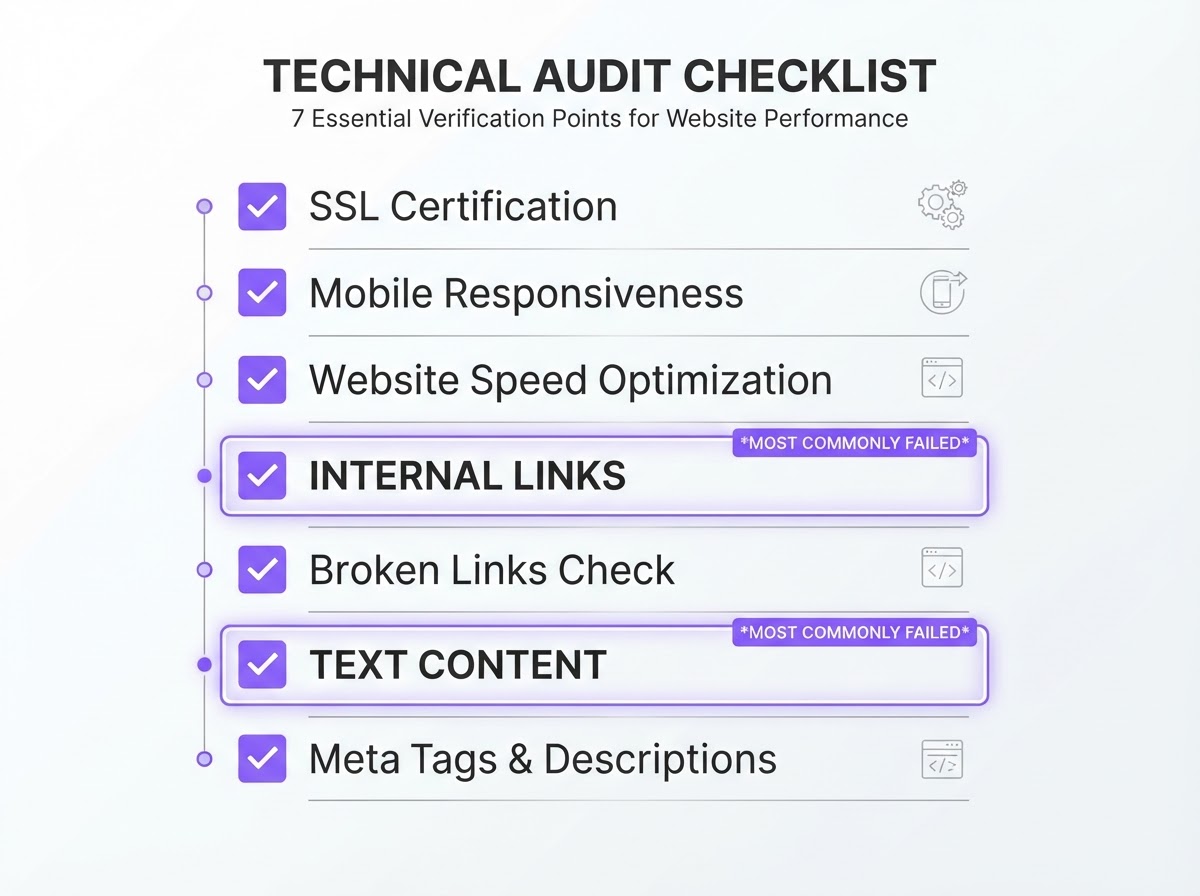
One list, not two. Google says the same foundational SEO best practices apply to AI features as to Search overall:
Two of those seven are internal links and text content, what most small business sites get wrong first. A five-page site with no links between the blog and the service pages is failing a Search fundamental that predates AI Overviews by a decade, and it is what a site built for growth fixes for less than a retainer.
That linking point is most of what we mean by a connected growth system: pages pointing at each other on purpose, not isolated islands under one header. Google is not asking you to build anything new. It is asking you to finish the site you started.
Not for search visibility. John Mueller compared llms.txt to the keywords meta tag, a field search engines stopped reading years ago, and said no AI services were requesting it. Gary Illyes and Amir Taboul confirmed at Search Central Live Deep Dive Asia Pacific that Google is not pursuing it, and Google's own optimization guidance says the file is not needed for these features.
Search Engine Journal reported those statements, and Contentful reviewed the wider evidence in June 2026, landing in the same place: "there is no widely validated evidence that llms.txt reliably improves AEO visibility, citation frequency, referral traffic, or inclusion in generated answers." A Seer Interactive analyst quoted there was blunter: Google does not use the file, "and server log audits back that up."
One exception, honestly. Chrome's Lighthouse carries an experimental audit checking for llms.txt under "agentic browsing readiness," a browser agent case, not a search ranking one. Build one for that reason if you like, just do not bill it as an AI Overviews requirement. Tell us if you have seen otherwise.
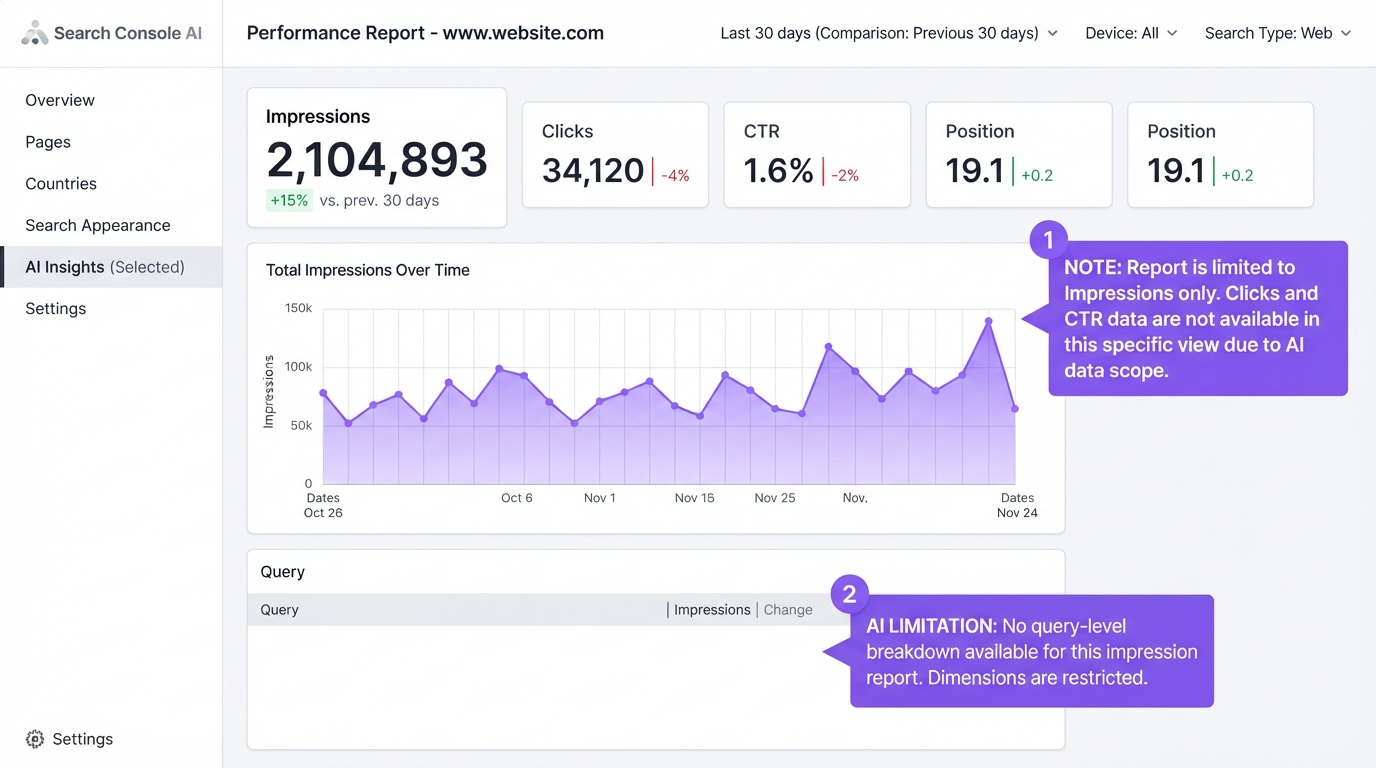
Measurement, not optimization. Google added Search Generative AI performance reports to Search Console on 3 June 2026, a dedicated view of impressions inside AI Overviews and AI Mode. I opened it expecting query level detail and got impressions only.
The report lives in the Search Console interface only. Neither the Search Analytics API nor the BigQuery bulk export exposes the data, so there is no official way to track it at query level. A meaningful share also disappears into an anonymized pool for rare queries: a site owner writing for Search Engine Journal measured 57.7 percent of their own impressions there as of 11 August 2026, one site's number, not an industry benchmark.
Nobody, including Google, has good query-level attribution for AI answers yet, which is the one part of the pitch that is not a fabrication. If a vendor claims they can show which citation sent a customer, ask for the data behind it. We did the same separation on what actually changed with Claude Opus 5: read what changed, not what got announced.
Run the check Google actually named, not the one from the proposal. Open robots.txt and confirm nothing important is blocked, at the CDN layer too. Pick five important pages and count internal links pointing at each from elsewhere on your site. Zero is the fix, not a new AI file.
View source on those pages and confirm the content a reader sees is present as text, not rendered only after a script runs. Compare structured data against the visible page. Turn on the Search Generative AI performance report this week for a baseline. None of that is new: it is the SEO fundamentals list, run honestly, with the AI report as a new gauge, not a new engine.
When a GEO or AEO retainer lands in your inbox, ask one question first: which of Google's named practices does this deliverable actually move? If the answer is none, you are paying twice for work your SEO should already cover. If it is a real gap, a blocked CDN, zero internal links, content locked in a slider, that is worth fixing regardless. WebFX's own published pricing puts small business GEO retainers at $1,500 to $5,000 a month on top of an existing SEO retainer, not small. We made a similar argument about why most businesses are not ready for AI sales agents: readiness matters more than the newest layer.
If you want a second read on your own site against this list before you renew or sign anything, book a strategy call. We will run the check with you, not sell you a file Google does not read.
No. Google says llms.txt is not used for its generative AI features. John Mueller compared it to the keywords meta tag, and Gary Illyes and Amir Taboul confirmed at Search Central Live Deep Dive Asia Pacific that Google is not pursuing it. It may matter for browser agents, not search visibility.
No. Google's documentation says there is no special schema.org markup needed for AI Overviews or AI Mode. What matters is that any structured data you use matches the visible text on the page. Adding AI specific schema on top of that is not something the documentation asks for.
A page has to be indexed and eligible to appear in regular Google Search with a snippet. That is the entire eligibility bar Google names. Beyond it, the same foundational SEO practices apply: crawlable pages, internal links, good page experience, and important content available as real text rather than an image.
Largely, yes, per Google's documentation, which names no additional technical requirements for AI features. What is genuinely new is measurement. Search Console's AI performance reports, added in June 2026, are useful but limited: no query-level API, no BigQuery export, and much of the data hidden in an anonymized pool.

Written by
Benison David Sanchez is the CEO and AI Digital Marketing Strategist of BDGS Digital, a technology, CRM, automation, and growth company based in the Philippines and serving clients globally. He leads digital marketing and client acquisition for the company, and over five years has worked with more than 100 businesses across ecommerce, service, coaching, accounting, and technology, building connected growth systems where every campaign ties back to a larger system rather than running in isolation. On this one, he read the documentation himself rather than repeating what the rest of the industry already wrote about it.
View all articles by BenisonWant help building this?
BDGS Digital builds connected growth systems across CRM, automation, marketing, and technology. Explore our services or book a strategy call.
Book a Strategy CallLET'S TALK
Book a strategy call and we'll map how your CRM, automation, marketing, and technology can work together as one connected system.