One GoHighLevel user rated the platform half a star on G2 in 2026 and said calls disconnected for thirty to forty five days straight, with no warning and no clear person to call about it. StatusGator, an independent monitor that has tracked GoHighLevel since January 25, 2024, has logged more than 143 outages in that window and gives GoHighLevel’s own status page an F for accuracy. We build client systems on GoHighLevel every week. So the question we actually get asked more often than “is it any good” is simpler and harder: how would you even know if it broke?
We already answered the “is it good” question in our honest read on GoHighLevel after building it for 100+ clients. This one is narrower. It is about what happens on the day the platform quietly stops doing its job, and whether you will find out before your customer does.
Is GoHighLevel Actually Down More Than It Lets On?
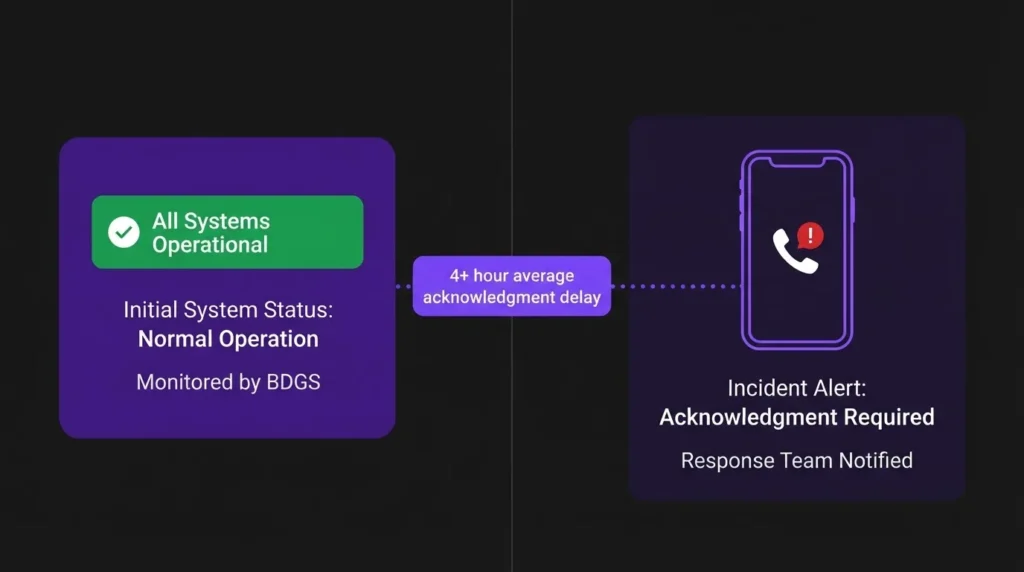
Yes, more than the marketing suggests, if you trust independent tracking over the vendor’s own framing. StatusGator monitors HighLevel across 55 components in 16 groups and has recorded over 143 outages since it started watching in January 2024. It sent more than 200 incident notifications to subscribers in that window, with individual incidents ranging from five minutes to nearly an hour. StatusGator rates the accuracy of GoHighLevel’s own status page an F, and says the average delay before an incident gets officially acknowledged runs past four hours, with many incidents never formally acknowledged at all before the independent monitor’s own users caught them.
That is not the full picture, though, and honesty about the gap matters here. We checked GoHighLevel’s official status page ourselves on September 5, 2026. It showed a green “all services online” banner and a real incident history underneath it, including a DNS connectivity problem and an appointment data visibility bug from early September, each with a short root cause note. So the page is not empty air. It logs real incidents. It just logs them on GoHighLevel’s own clock and its own judgment of what counts, which is exactly why an independent second read matters.
Why the Status Page Didn’t Warn You Last Time
Because plenty of users say it has not, at the exact moment they needed it to. GoHighLevel’s own community has a feature request titled Outage or Incident Status Page with 97 votes, still tagged as a new, unresolved feature two years after the original ask. Read the comments and the pattern is specific: one user says the page “doesn’t ever load when there’s an outage, so we’re left in the dark.” Another describes it going to “nothing but a blank white page” during an incident. A third reports contact data that vanished and then “mysteriously re-appeared a couple of hours later,” with no confirmation from GoHighLevel of what had actually happened in between.
We are not saying the page is useless. We are saying it is inconsistent, and “all green” on a dashboard you do not control is not the same thing as “nothing is wrong for you right now.” If your workflow silently stopped firing an hour ago, the status page telling you everything is fine is not proof that it is.
What Actually Breaks When It Goes Down
The pattern in real reviews is not vague slowness, it is specific channels failing at specific moments. On G2, one reviewer, rated 0.5 out of 5, described a home services business where “calls disconnect and none of them come through” for over a month, with support unable to help beyond password resets. Another, at 0.0 out of 5, said “support will open a ticket, but after that I never hear back,” despite bugs that made parts of the platform unusable. A third reviewer, who otherwise gave GoHighLevel a positive 4.0, still flagged “outages without notice or communication” as a real operating condition, not a one-off.
Here is the mechanism that makes this worse than a typical SaaS outage. GoHighLevel is usually not one tool in a stack, it is the control plane: calendar, phone and SMS, forms, and the workflow automation that ties them together, all inside one sub-account. That is the same connected growth system idea we build client work around, and it cuts both ways. When a single-purpose ad platform has a bad hour, one campaign pauses. When the platform running the lead routing workflow, your missed-call texts, and your appointment reminders has a bad hour, several things that look unrelated to a business owner fail at the exact same time, and none of them come with an obvious shared cause unless you already know to check the platform first.
The Three-Check Reliability Protocol We Actually Run
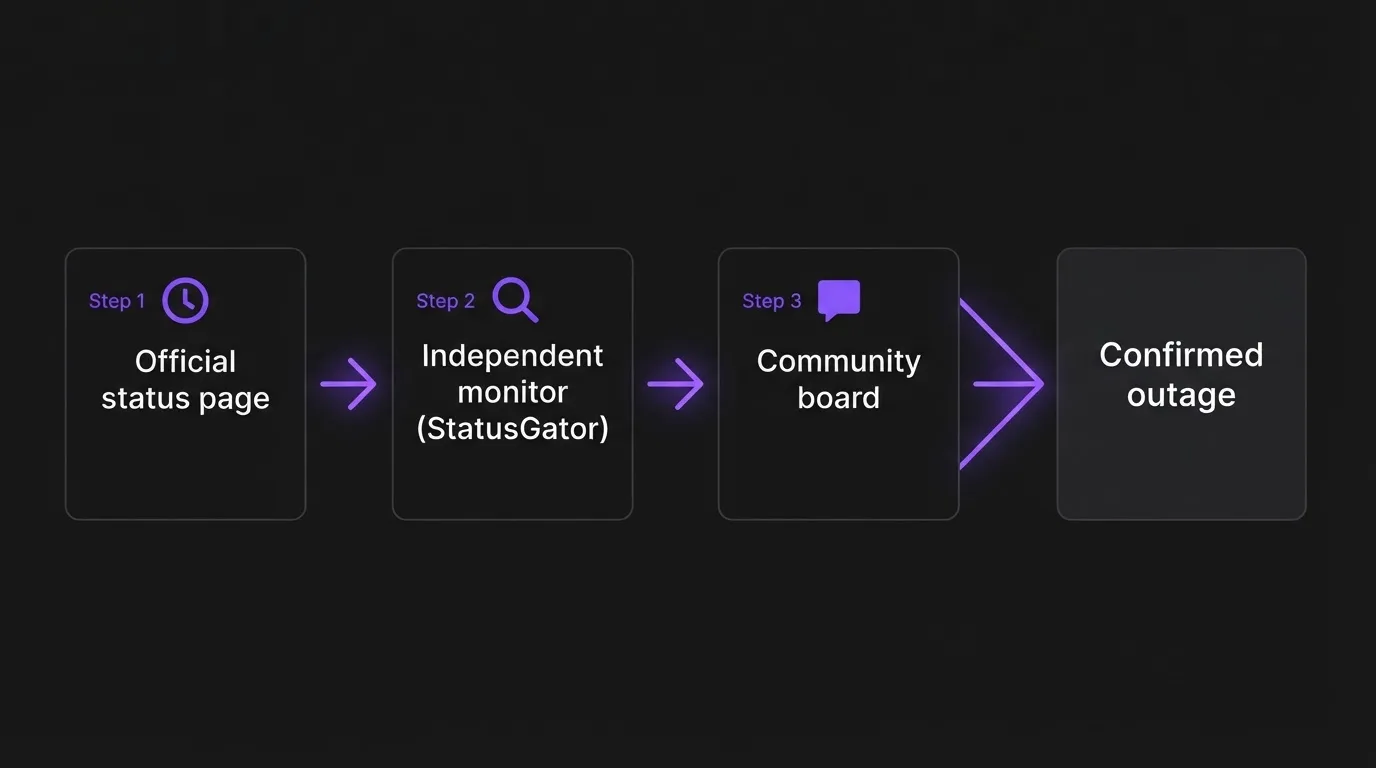
This takes under five minutes and it is what we tell every client to do the moment something feels off, before opening a support ticket.
- Check the official status page first, at status.gohighlevel.com. It does carry real incident detail, as we confirmed directly, just on GoHighLevel’s own timeline and its own definition of what is worth posting.
- Cross-check an independent monitor second, specifically StatusGator’s HighLevel page. It is not owned by GoHighLevel, it aggregates crowdsourced reports alongside its own monitoring, and its history goes back further than most users would think to look.
- Check the community third, on the ideas board or in agency Facebook groups running GoHighLevel. If ten people are describing the same symptom in the same hour, that is often faster confirmation than either status page, official or independent, because it is happening in real time rather than after a review cycle.
None of these three tells the truth alone. Together they usually do.
What We Actually Build So an Outage Doesn’t Cost a Client a Lead
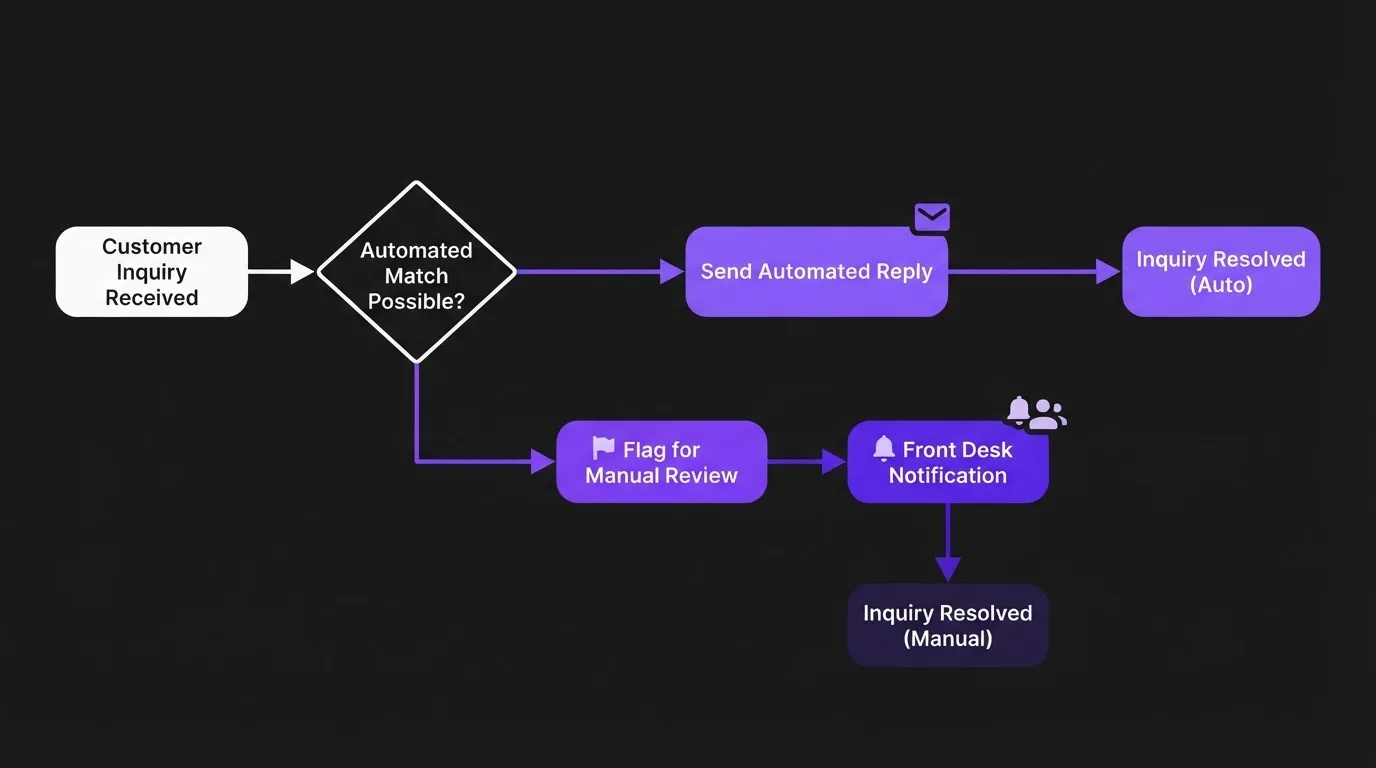
We do not route any single time-critical channel through GoHighLevel without a fallback the front desk actually knows how to trigger by hand. Missed-call-text-back is the clearest example: we covered the compliance side of that automation in our piece on missed call text back rules, but the resilience side matters just as much. If the automation stops firing, someone on the client’s team needs to know within the hour, not find out three days later when a lead complains that nobody replied.
We will admit where we got this wrong before we got it right. Early on, we trusted a client’s dashboard showing green for longer than we should have, because we had no independent check running and no one was watching the actual message logs. A sync workflow sat quietly broken for the better part of a week before we caught it ourselves. That is the reason the three-check protocol above is not theoretical for us. We built it after being burned by exactly the failure mode this article describes.
We also do not promise clients a support response time GoHighLevel itself does not guarantee. Reviewers describe ticket response as inconsistent, and we would rather set that expectation honestly up front than have a client discover it during their first real incident. This is also why the automation layer we build always keeps a documented manual override, not just an automated happy path.
We Would Like to Hear From You
If you are building client work on GoHighLevel and have your own outage story, especially one that contradicts ours, we want to hear it. Reply and tell us what broke and how you actually found out.
If your lead capture, follow-up, and reporting are already tangled together on one platform and you are not sure what happens the next time it hiccups, book a strategy call. We will map what you are running today and where a single outage would actually hurt.
Frequently asked questions
Check both status.gohighlevel.com and an independent monitor like StatusGator’s HighLevel page, since the two do not always agree in real time. The official page reflects GoHighLevel’s own detection and judgment call on what to post, while an independent monitor often surfaces a problem sooner because it is not waiting on internal acknowledgment.
There is no equivalent independent monitoring data for competing platforms to make a fair number for number comparison. What practitioner experience shows is that because GoHighLevel bundles calendar, phone, SMS, and automation into one sub-account, a single outage tends to touch more of a business’s operations at once than an outage in a narrower, single-purpose tool would.
Scheduled maintenance does get posted in advance on the official status page, such as a WhatsApp template generator maintenance window logged for August 31, 2026. Active incidents are different: they get logged after detection, not predicted ahead of time, and user reports describe acknowledgment lagging behind the actual problem.
Run a three-way check: the official status page, an independent monitor, and the community board, in that order. In parallel, switch on whatever manual fallback exists for time-critical channels like missed-call texting or appointment confirmations, and confirm recovery the same way the outage was confirmed rather than assuming a green dashboard means every workflow resumed.