On October 13, 2026, HighLevel raises per-minute voice prices for calls to and from more than 20 countries inside the GoHighLevel Phone System. Its changelog entry lists every route. Outbound calls to the Philippines go from $0.2066 to $0.2370 a minute on standard lines and from $0.2938 to $0.3325 on mobile, increases of roughly 13 to 15 percent.
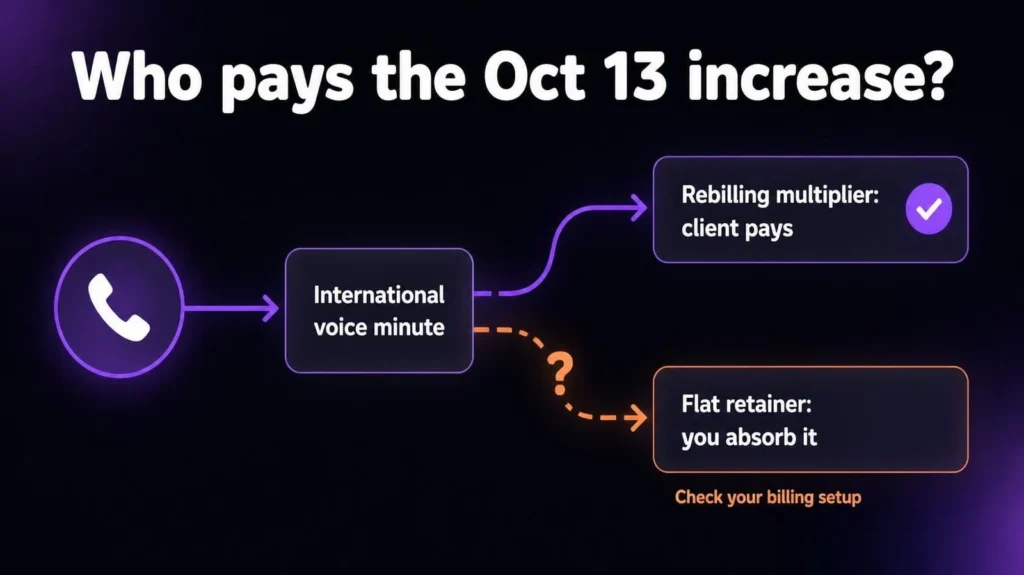
The rate table is the headline. The question that matters for an agency is simpler: when the cost goes up, who pays the difference, you or your client? The answer depends entirely on how you bill phone usage today, and a lot of agencies are not sure which setup they are on.
What changes on October 13
The update covers inbound and outbound minutes on international routes. A few examples from HighLevel’s own table:
| Route | Old, per min | New, per min |
|---|---|---|
| Philippines outbound, standard | $0.2066 | $0.2370 |
| Philippines outbound, mobile | $0.2938 | $0.3325 |
| Morocco outbound, mobile | $1.0748 | $1.2354 |
| Germany outbound, standard | $0.0283 | $0.0332 |
| UAE inbound, toll free | $0.3675 | $0.4220 |
HighLevel says no action is required and the new list prices apply automatically. The one exception it names: if you have an active fixed-price agreement covering an affected route, your contracted rate holds until that agreement ends.
This is also not a one-off. The same changelog shows voice price changes in May 2025, August 2025, and September 2025. If your client pricing assumes international voice costs stay flat, that assumption has already broken several times.
Who absorbs the increase depends on how you bill
There are three common setups, and each one handles October 13 differently.
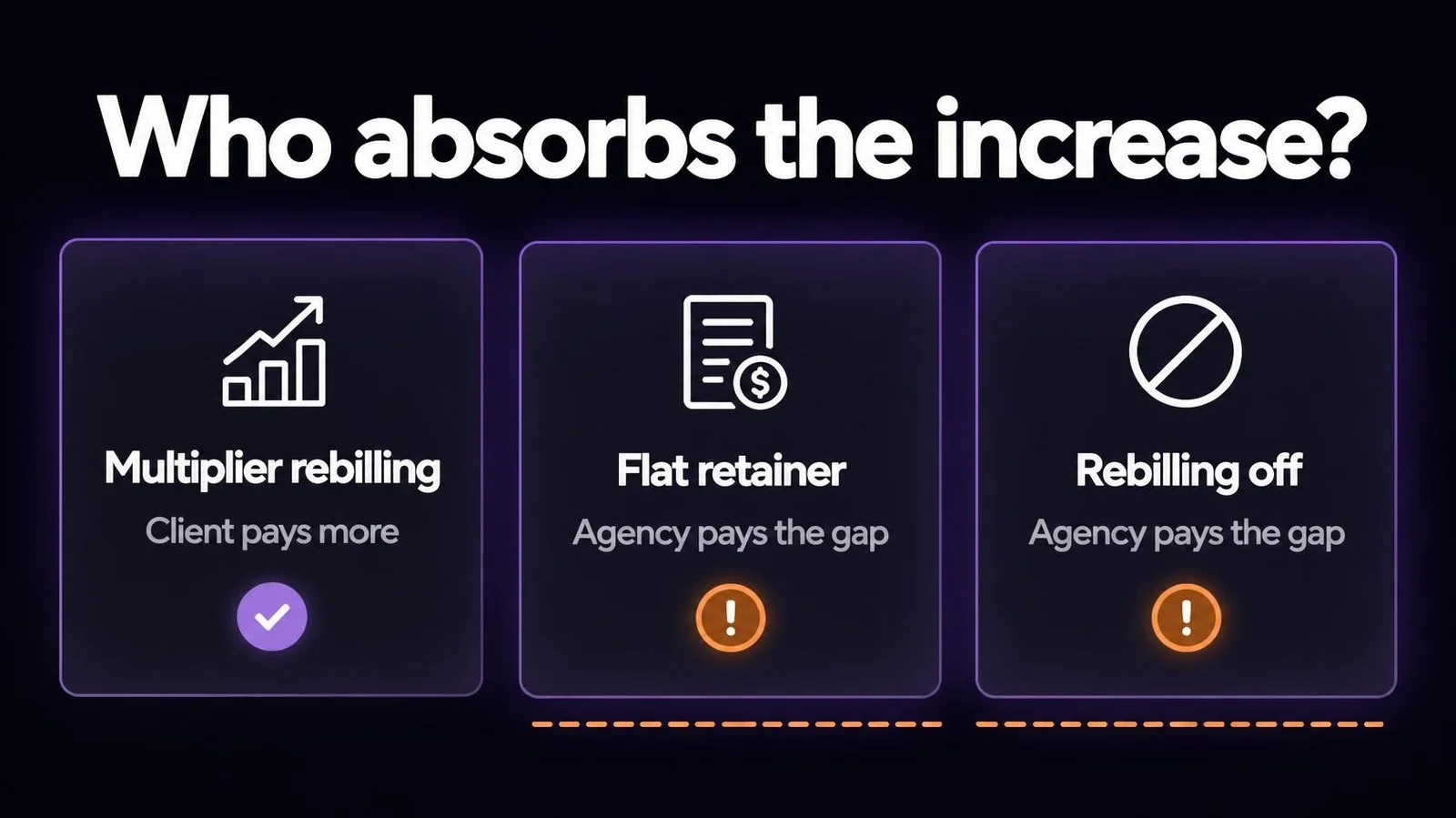
You rebill phone usage with a multiplier. HighLevel’s Phone System Pricing and Billing Guide describes the Resell Amount under Agency View, Reselling, Core Services as a rebilling multiplier. Because a multiplier scales with the underlying cost, the increase flows through to your client automatically, multiplied by whatever you set. You are protected. Your client is the one who sees a bigger bill, and on high-volume international routes they will notice.
You bundle calling into a flat retainer. If the client pays a fixed monthly fee that includes “phone” and the minutes come out of your agency wallet, every cent of the increase comes out of your margin. Nothing in HighLevel adjusts for you here, because the client price lives in your contract, not in the platform.
Rebilling is off for that sub-account. Same result as the flat retainer. The wallet pays the new rate and you absorb it until you change something.
One thing that does not protect you either way: the fixed 5 percent location-level markup. HighLevel’s explainer on that markup is clear that it applies only to pass-through categories (A2P registration fees, SMS and MMS carrier fees, Verified Caller ID, and RCS carrier fees). Per-minute voice is not on that list, and the markup is HighLevel’s own charge, separate from whatever you configure for your clients.
What to check before the 13th
The check takes a few minutes in screens you already have:
- Open Agency View, Settings, Billing, Wallet and Transactions, and filter recent transactions by product to find which sub-accounts are making international calls.
- Compare those destinations against the countries in HighLevel’s October 13 list. Any overlap is a route where cost per minute is about to rise.
- For each affected client, confirm how you bill them: multiplier rebilling, flat retainer, or rebilling off.
- If you rebill with a multiplier, give the client a short heads-up. A higher phone line item with no warning is how a pricing change turns into a trust problem.
- If you bundle or absorb calling, decide now whether to reprice, cap minutes, or eat the difference for this cycle. Make that a decision, not a surprise on next month’s statement.
- If you have never separated domestic and international voice in your client pricing, this is a good moment to start. They move on different schedules.
What this does not change
US and Canada calling is not part of this update. Those routes run on their own discounted rate, a 10 percent discount on list price per HighLevel’s guide. A2P, SMS, and MMS pricing are not touched either. If every client you serve calls only within North America, this changelog entry is background noise.
We would also push back on reading this as HighLevel being greedy. International termination costs move often, and four adjustments in under two years tracks with that. The real risk is a client pricing model that treats a variable cost as a fixed one.
Frequently asked questions
Does GoHighLevel’s 5 percent markup apply to international voice calls?
No. HighLevel’s documentation limits the fixed 5 percent location-level markup to pass-through categories: A2P registration fees, SMS and MMS carrier fees, Verified Caller ID, and RCS carrier fees. Per-minute voice is billed at its own rate, and any agency resale on top of it comes from the rebilling multiplier you configure.
Will my GoHighLevel voice rates go up automatically on October 13, 2026?
Yes, unless you have an active fixed-price agreement covering the affected route. HighLevel’s changelog says no action is required and the new list prices take effect automatically on October 13, 2026.
If I rebill phone usage to clients, does the increase pass through?
If you rebill with a multiplier set under Agency View, Reselling, Core Services, the multiplier applies to the new, higher cost, so your client’s charge rises with it. If you bill clients a flat fee that includes calling, or rebilling is off, your agency absorbs the increase.
Has GoHighLevel changed voice pricing before?
Yes. HighLevel’s changelog shows voice pricing updates effective May 12, 2025, August 11, 2025, and September 12, 2025, before this October 13, 2026 change.
How do I find out which clients are affected?
Filter your wallet transactions by sub-account and product to see who makes international calls, then compare their destinations against the countries listed in HighLevel’s October 13 changelog entry.
Where this fits
Phone billing is one more place where the CRM, the phone system, and client pricing are supposed to work as one system and often do not. We wrote about how we think about connected growth systems, and our honest GoHighLevel review covers the rest of the platform’s cost of ownership. If your sub-accounts make calls, the compliance side of GoHighLevel’s phone features is worth a read too.
If you want a second pair of eyes on how your sub-accounts are priced, our CRM and GoHighLevel team can walk through it with you. Book a discovery call and we will look at where the gaps are.