We went looking for the sentence in GoHighLevel’s Voice AI Agent setup guide that tells a caller they are talking to a bot. We could not find one. The guide walks through naming the agent, writing a role prompt, connecting a knowledge base, setting call transfers, and tuning silence timeouts. Nothing in it tells the business what the agent should say about itself when it picks up.
That gap is not unique to GoHighLevel. HubSpot’s AI settings documentation has the same blind spot. And the gap matches the shape of the law right now: uneven, split by channel, and mostly aimed at a kind of AI call that is not the one most small businesses turn on first.
Three kinds of “AI talking to a customer”
Most guides on this topic treat AI voice compliance as one subject. It is not. The rules split along a line most business owners never think about: who started the conversation.
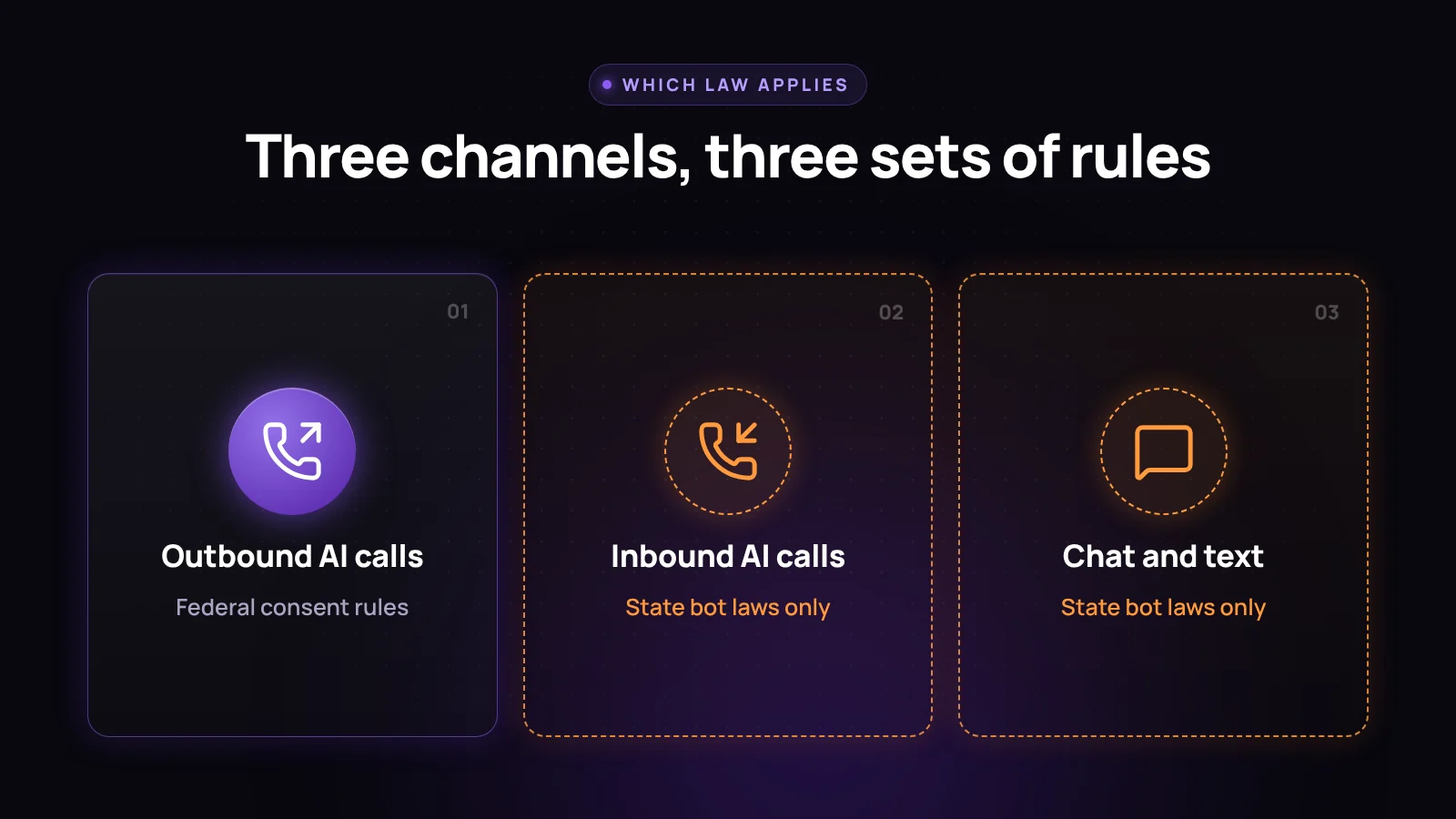
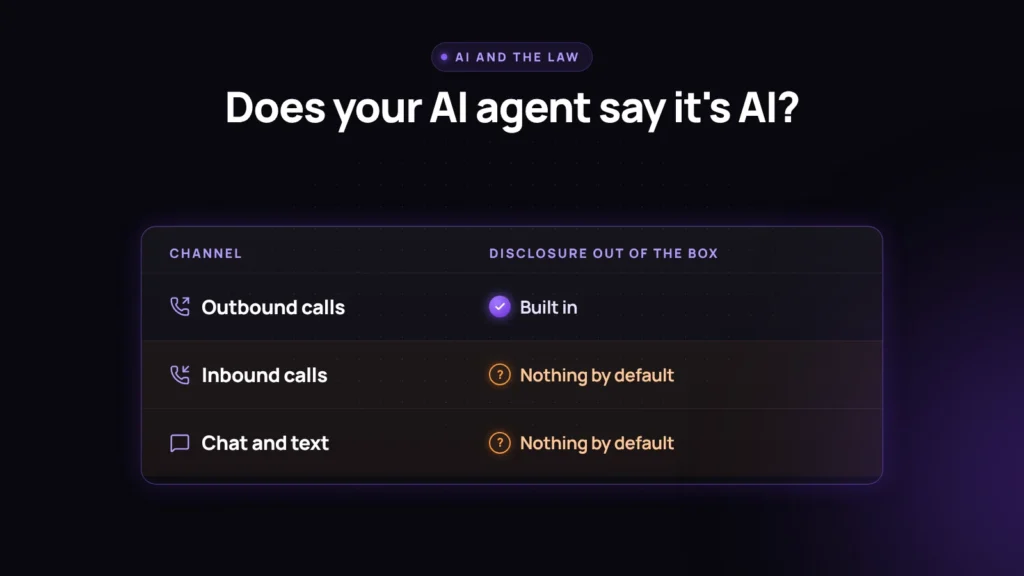
Outbound AI calls. When your business places the call, the Telephone Consumer Protection Act applies. The FCC ruled on February 8, 2024 that an AI-generated voice counts as an “artificial voice” under the TCPA, so the same prior-consent rules that govern robocalls now apply to AI calls. That is a federal rule with real penalties.
Inbound AI calls. When a customer dials your number and your AI agent answers, the TCPA’s consent rules do not engage, because you did not place the call. That is not a free pass. It means the rules that might apply are state bot-disclosure laws, not federal telemarketing law.
Chat and text. A website widget, an SMS conversation, or a HubSpot chat agent falls under a different set again, mostly state laws written with online commerce in mind.
Three channels, three legal postures. Untangle that first before you change anything in your setup.
What GoHighLevel built, and where it stops
GoHighLevel is part of our own service stack, so we have a reason to want it to look good. We are flagging the gap anyway, because a client asking us this question deserves a straight answer.
For outbound Voice AI, GoHighLevel ships a real compliance feature: an AI disclaimer setting with styles it calls Concise, Standard, and Conversational. Its outbound compliance article is clear about where responsibility sits. Businesses remain responsible for deciding whether a contact can legally receive an outbound AI call, and accepting the platform’s terms does not count as permission to call anyone. The tool gives you the disclosure sentence. It does not give you the consent you need before you say it.
For the inbound Voice AI Agent, the one that answers your main line, the prompt guidance covers the agent’s role, what to collect, what to avoid, and when to transfer to a human. We found nothing about the agent identifying itself as AI, and no sample disclosure line for the Welcome Message.
So GoHighLevel saw the exposure on the outbound side and built for it. On the inbound side, which more small businesses turn on first because it needs no contact list or consent flow, the fix sits with you.
What HubSpot ships
HubSpot’s AI settings cover account-level controls: turning generative AI features on or off, deciding what data its AI can see, and keeping output on-brand. None of it addresses what a website visitor is told about the AI on the other end. A HubSpot chat agent can greet a visitor, qualify them, and hand them to a human without the business ever being prompted to add a disclosure line.
Same pattern as GoHighLevel. Both vendors solved compliance where the regulatory pressure is loudest, outbound calling, and left the quieter surfaces to the business.
The state laws that actually touch this
Most guides turn this into a fifty-state spreadsheet. We are staying narrow on purpose, because a lot of what gets cited does not apply to an ordinary customer service or sales agent.
California’s B.O.T. Act (SB 1001, in force since July 1, 2019) is the one cited most. Read the chaptered text and it targets bots used with intent to mislead someone about their artificial identity to drive a sale or influence a vote. It reads like it was written for fake accounts, not a plumbing company’s chat widget. We would still disclose: it costs one sentence and removes the argument.
Utah’s AI Policy Act, as amended, mainly covers generative AI in regulated occupations and high-risk interactions, plus a duty to disclose when a consumer clearly asks. A typical booking or support chat does not trigger it.
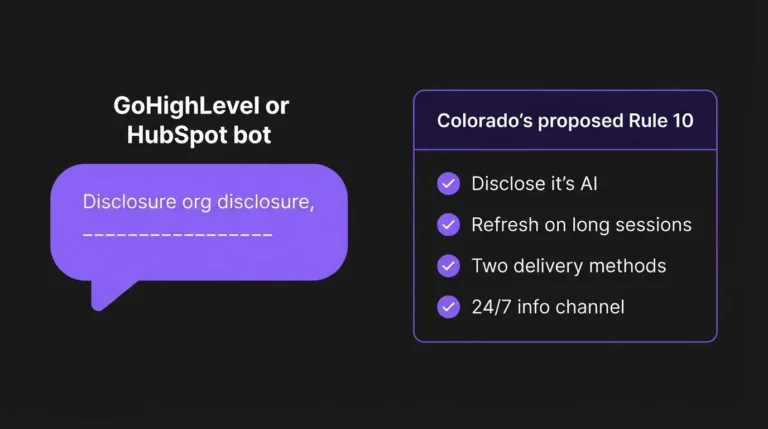
Colorado’s Chatbot Safety Act (HB 26-1263) takes effect January 1, 2027, and it is the one worth watching. We covered it in detail in our post on Colorado’s AI chatbot disclosure rules. The open question for small businesses is whether running a vendor’s built-in agent makes you an “operator.”
California’s SB 243, effective January 1, 2026, is about companion chatbots built to sustain an ongoing relationship with a user. It excludes bots used only for customer service or business operations, so an ordinary sales or support agent almost certainly falls outside it.
The one line to add today
This is not legal advice. If your setup touches health, legal, or financial decisions, or you operate in a state actively rewriting its rules, talk to a lawyer who covers your jurisdiction. For the ordinary case, the fix takes about five minutes.
- GoHighLevel inbound Voice AI Agent: add the disclosure as the first line of the Welcome Message, or as the opening instruction in the role prompt. Something as plain as “You are speaking with [Business Name]’s AI assistant.” Test it in the call preview before publishing.
- HubSpot chat agent: label the first message as coming from an AI assistant, instead of the named “team member” persona many businesses leave in place.
- Outbound AI calls on either platform: turn on the built-in disclaimer, and separately confirm you have consent for every contact you call.
Neither edit needs a developer. If you are also running texting automations, the same thinking applies to missed call text back compliance.
Frequently asked questions
Does my GoHighLevel Voice AI Agent have to tell callers it’s AI?
There is no specific federal rule for inbound calls, because the TCPA’s consent requirements cover calls a business places, not calls it receives. State bot laws such as California’s B.O.T. Act focus on bots used to mislead, so a transparent agent is unlikely to be caught. Disclosing anyway costs one sentence and removes the question.
Does the FCC’s AI voice ruling apply to inbound calls?
No. The FCC’s February 8, 2024 ruling applied the TCPA to AI-generated voices in calls a business makes. A customer calling a business and reaching an AI agent is not a call the business placed.
Does GoHighLevel have an AI disclosure setting?
Yes, for outbound Voice AI calls. GoHighLevel offers an AI disclaimer with Concise, Standard, and Conversational styles. We did not find an equivalent setting or guidance for the inbound Voice AI Agent, so the disclosure line has to be added to the welcome message or prompt.
Does California’s BOT Act apply to customer service chatbots?
The law targets bots used to mislead someone about their artificial identity in order to drive a sale or influence a vote. A clearly labeled customer service bot is unlikely to trigger it, but labeling it is the safest move.
When does Colorado’s AI chatbot law take effect?
Colorado’s Chatbot Safety Act (HB 26-1263) takes effect January 1, 2027. The state is still working out how it applies to businesses that run a vendor’s built-in AI agent.
Where this leaves you
We would rather see this fixed in five minutes than argue about whether a 2019 statute reaches a chat widget. If you are running an AI voice or chat agent and want a second pair of eyes on the setup, our AI and automation team can review it, and our CRM and GoHighLevel team can make the change. Before you add more agents, it is also worth reading why most small businesses are not ready for AI sales agents yet. Book a discovery call and we will look at what you have live.