We keep hearing a version of the same question from clients: the site ranks on page one of Google, so why does ChatGPT never mention the business when someone asks for a recommendation in that exact industry? Most of the advice going around blames the wrong things. It is rarely your schema markup, and it is almost never a missing llms.txt file. The real answer sits in how ChatGPT decides what to read in the first place.
The advice going around is mostly guessing
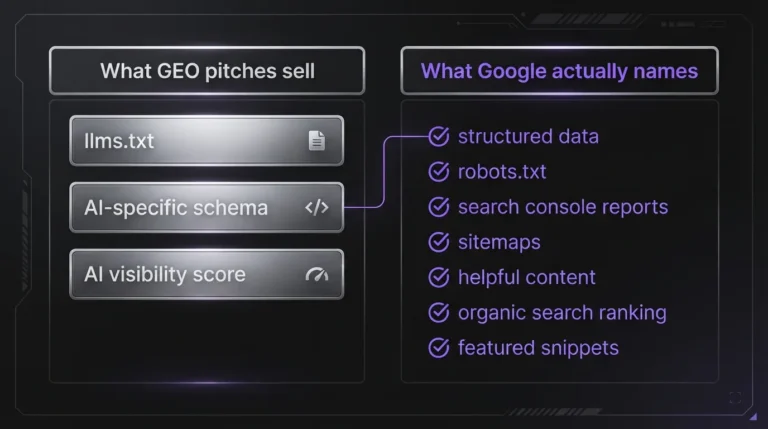
We already covered what Google actually requires to rank in AI Overviews: ordinary SEO, nothing exotic. Google’s John Mueller has said directly, more than once, that Google does not use llms.txt and that hosting one is not an endorsement of the format.
That settles Google. It does not settle ChatGPT or Perplexity, and most “GEO checklist” content treats all three as the same system. They retrieve pages differently, so the fix for one is not automatically the fix for another.
How ChatGPT actually finds and reads pages
The most detailed public look at this is a study by the consultancy RESONEO, published on Search Engine Land in August 2026. The team captured 1,200 ChatGPT answers and tens of thousands of search results, and what they found contradicts a common assumption.
ChatGPT does not simply run on Bing. OpenAI has its own index, which shows up internally as “labrador,” and only 1.5 percent of its URLs appeared in Bing’s top 20 for the same queries. Alongside it, ChatGPT buys scraped Google results through third-party providers.
Which source you are judged by depends on the mode:
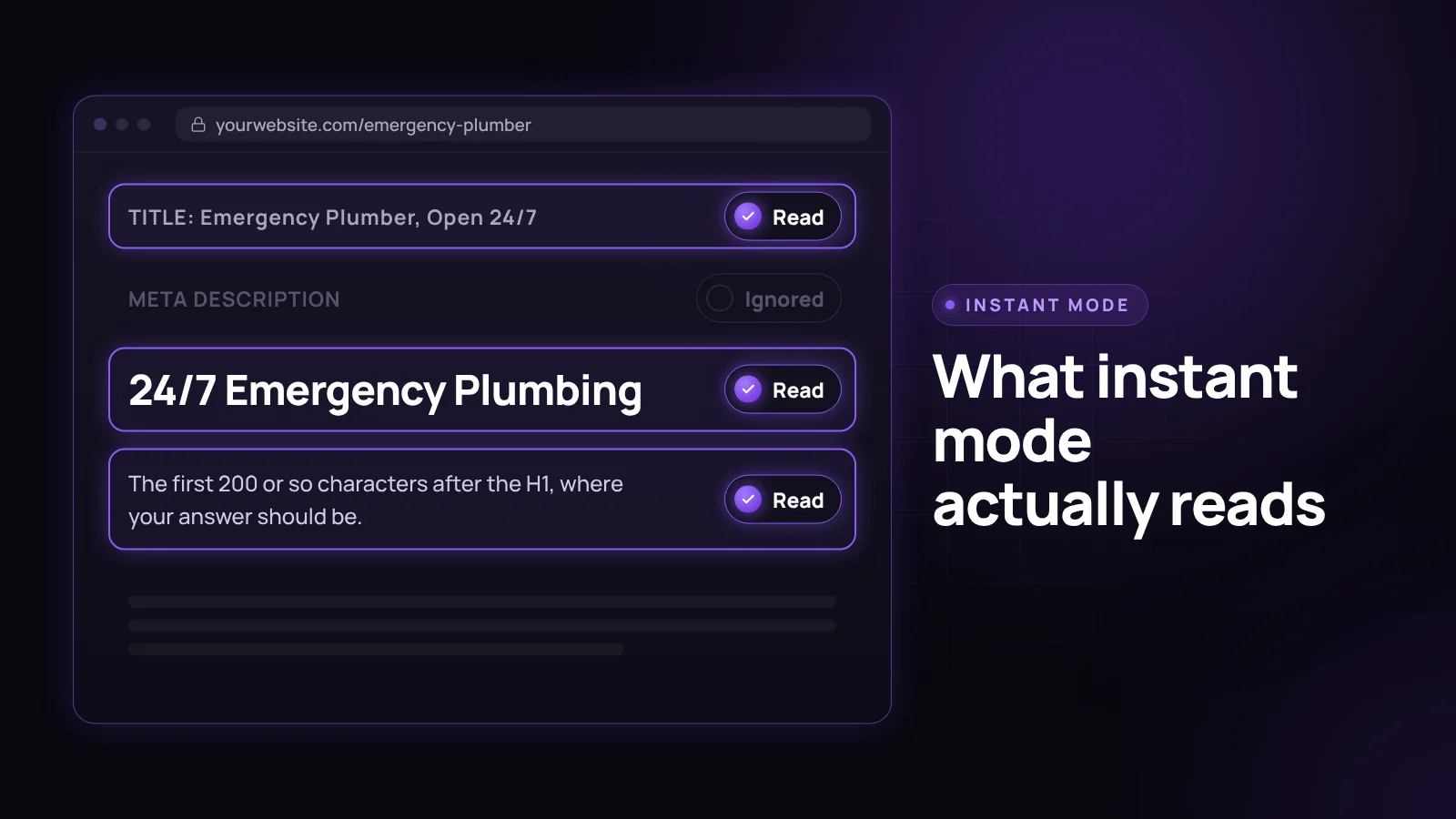
- Instant mode (what free users get by default) leans on OpenAI’s own index. In 93 percent of the instant answers captured, no page was opened at all. The answer is grounded in your page title and a snippet of about 200 characters anchored on your H1. Your meta description is ignored.
- Thinking mode pulls far more results, mostly scraped Google rankings, and actually opens pages to read them.
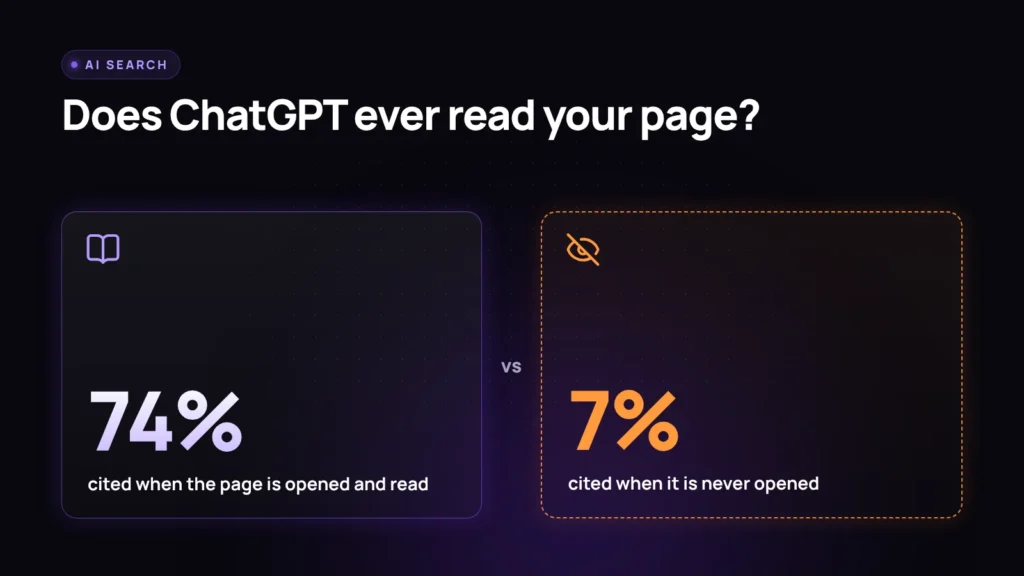
The funnel numbers from the study make the stakes clear. Across the corpus, 61,332 URLs were surfaced as sources, 5,032 became the lead source behind a citation, and only 759 pages were opened, all in thinking mode. An opened page was cited 74 percent of the time. A page that was retrieved but never opened was cited in 7 percent of cases.
When ChatGPT does open a page, a few hard limits apply. Its fetcher does not execute JavaScript, so content rendered client-side is invisible. Pages over 4 megabytes are rejected outright and never read. And JSON-LD structured data is stripped when the page is converted to text, so your schema never reaches the model through that path.
The study’s authors are open about what they could not pin down, including which OpenAI bot populates the labrador index. The system is changing week to week, which is a good reason to be skeptical of anyone selling a guaranteed fix.
Perplexity is easier to reason about
Perplexity publishes what its crawlers do. According to Perplexity’s crawler documentation, PerplexityBot builds the search index used to surface and link sites, and it respects robots.txt. A second agent, Perplexity-User, fetches a page live when a person’s question needs it, and it generally ignores robots.txt because a human triggered the request.
The practical takeaway is short: keep PerplexityBot unblocked, keep pages light and readable without JavaScript, and you are doing most of what is in your control.
What the data says about who gets cited
Semrush’s 2026 AI Visibility Index analyzed 126 million US AI search prompts from January through April 2026 across ChatGPT, Gemini, Google AI Mode, and Google AI Overviews. Two findings matter for a smaller business:
- ChatGPT cites an average of 15 sources per response. Gemini cites an average of 3. The platform changes how many doors are open.
- Concentration varies a lot by industry. The top 3 brands hold 82.9 percent of visibility in news and media, but only 41.4 percent in finance and 42.2 percent in industrial. Some categories have far more room for a smaller player.
The same release found that 45 percent of marketing leaders cannot accurately measure their brand’s visibility in AI answers. If large marketing teams cannot measure it reliably, treat any vendor promising guaranteed AI citations with suspicion.
The pattern we check for first
When we review a site for this, the first thing we look for is content that only appears after JavaScript runs: service lists, pricing tables, or location details loaded by a script after the page paints. A human sees them fine. A fetcher that does not run JavaScript sees an empty shell. Moving that content into the initial HTML does not guarantee a citation, but it removes a reason the page cannot be read at all. That is the kind of fix our web development work covers, and you can see the types of builds we do on our Work page.
Three checks you can run this week
You do not need a GEO subscription for any of these.
Check what a non-JavaScript reader sees. Open your homepage and top service pages, then view the page source instead of the rendered page. If your services, pricing, or location are missing from the raw HTML, a crawler that skips JavaScript sees nothing there either.
Check the top of every important page. Read the first 200 characters after your H1. If that space is taken up by a category label, a date, or a table of contents, that is what ChatGPT’s instant mode sees about your page. Put your core message right under the heading.
Check robots.txt and page weight. Go to yourdomain.com/robots.txt and look for GPTBot, OAI-SearchBot, PerplexityBot, and ClaudeBot. If one is blocked and you did not mean it, that is a five-minute fix. Then check image-heavy pages, since a large catalog or gallery can cross the 4 megabyte limit once everything loads.
What we would tell you on a call
Skip the paid llms.txt add-on and put that budget into whatever the three checks turn up. Keep important content in the initial HTML, write titles and opening lines that stand on their own, keep AI crawlers unblocked on purpose, and keep pages light. Most of that is the same discipline that makes a site fast and crawlable for Google, which is probably not a coincidence. If you want to know whether that traffic turns into customers, we also wrote about tracking AI referral traffic into your CRM.
Frequently asked questions
Does ChatGPT use Google or Bing to search the web?
Not Bing, mostly. In instant mode, ChatGPT leans on OpenAI’s own index, which overlapped with only 1.5 percent of Bing’s top 20 results in a RESONEO study published on Search Engine Land in August 2026. In thinking mode, it relies heavily on scraped Google results bought through third-party providers.
Do I need an llms.txt file for my small business website?
There is no credible evidence it helps right now. Google has said it does not use it, and OpenAI’s crawler documentation points site owners to robots.txt, not llms.txt, to control access.
Can a JavaScript-built website show up in ChatGPT’s answers?
Only if the content you want cited is in the initial HTML. The fetcher ChatGPT uses to read pages does not execute JavaScript, so anything rendered client-side is invisible to it.
Does schema markup help my content get cited by ChatGPT?
Not directly. The RESONEO study found JSON-LD is stripped when ChatGPT converts a page to text. Schema still helps Google and other systems understand your site, but it is not what gets you cited in a ChatGPT answer.
How is showing up in ChatGPT different from ranking on Google?
Google ranks pages it has indexed. ChatGPT has to surface your page, and in thinking mode open it, before it can cite it. In the RESONEO sample only about 1.2 percent of surfaced URLs were ever opened, so a good Google ranking does not guarantee ChatGPT reads your page.
Tell us what you are seeing
We are working from primary documentation and the best independent study available as of this writing, not a controlled experiment of our own. If you have tested this on Perplexity or Gemini and found something different, we want to hear it.
If you would rather have someone check your site than run the tests yourself, our SEO team can look at your actual robots.txt and rendered HTML. Book a discovery call and we will tell you plainly what is blocking you and what is not worth touching yet.